How Fonetic English Can Help Struggling Readers
Many children and adults who struggle to read are intelligent, capable learners. Their difficulty may not arise only from the learner or the teaching. Part of the problem is that English spelling frequently does not provide enough information to pronounce an unfamiliar word accurately.
A reader may not know which sound a character represents, whether two characters form a digraph, which characters are silent, where the syllables divide or which syllable is stressed. Trying different possibilities places a heavy demand on working memory—the limited mental space used to process new information.
For struggling readers, including many people with dyslexia and other learning differences, this can make reading slow, tiring and frustrating. They are being asked to solve an information problem as though it were a memory problem.
The Writing System Makes a Difference
Research comparing languages shows that the transparency of a writing system can have a major effect on reading.
Italian spelling represents pronunciation much more consistently than English. A study comparing adults with dyslexia in Italy, France and the United Kingdom found a similar neurological basis for dyslexia in all three groups. However, the Italian participants read words and nonwords more accurately than the English and French participants. The researchers identified Italian university students with dyslexic profiles even though formal diagnosis was rare among Italian adults at university level. Their neurological difference remained, but the more consistent writing system reduced its effect on reading accuracy. (Paulesu et al., 2001)
A separate study examined Italian children with autism. It found that they had largely preserved decoding skills when reading text, words and invented words in Italian’s regular spelling system—including children with borderline intellectual functioning. Some still experienced difficulty with reading comprehension, which is a different skill, but their ability to decode written words was comparatively strong. (Zuccarello et al., 2015)
These findings do not mean that consistent spelling removes dyslexia or autism. They demonstrate something equally important: the writing system can either reduce or increase the reading difficulty associated with a learner’s neurological profile.
Words Are Easier to Remember When They Make Sense
Human cognitive architecture helps explain why. People remember new information more easily when it forms an understandable relationship with something they already know.
A word that can be sounded out accurately makes sense. The reader can connect its written characters with its sounds, recognise the spoken word and connect it with its meaning. Its spelling, sound and meaning can then be stored together in long-term memory.
The number of repetitions needed varies greatly between learners and words. Some children can sound out a readily decodable word once and recognise it as a sightword the next time they see it.
When an erratically spelled word cannot be decoded accurately, the relationship between its visual form and sound may appear arbitrary. Some children can remember this association easily, but a struggling reader may need to encounter the same word many times—sometimes as many as 20 to 50 times—and may still forget it.
Fonetic English Supplies the Missing Information
Fonetic English supplies the pronunciation information that ordinary English spelling leaves out—without changing the spelling.
Superscripts identify the sounds represented by characters.
Grey characters show what is silent.
Syllable marks divide longer words, and a stress mark identifies the stressed syllable.
The learner does not have to memorise a replacement spelling or learn a new phonetic alphabet. FE makes the conventional English word understandable.
Why “Sound It Out” May Not Be Enough
A child who cannot read a word is often told to “sound it out”. However, this advice can be misleading if the child has not been shown which characters represent separate sounds and which form digraphs.
Consider chart. A child may try to sound its five characters separately:
But combining those five character sounds does not produce chart. The child must recognise that ch represents one sound and ar represents another. The word contains three phonemes:
A digraph contains two characters representing one sound. The ch sound cannot be produced by saying the usual sound of c and then the sound of h. Children need to learn digraphs and be reminded when two characters in a word operate as one sound unit.
Fonetic English marks these digraphs explicitly. Its Sounding Out Syllables tool then builds the syllable progressively:
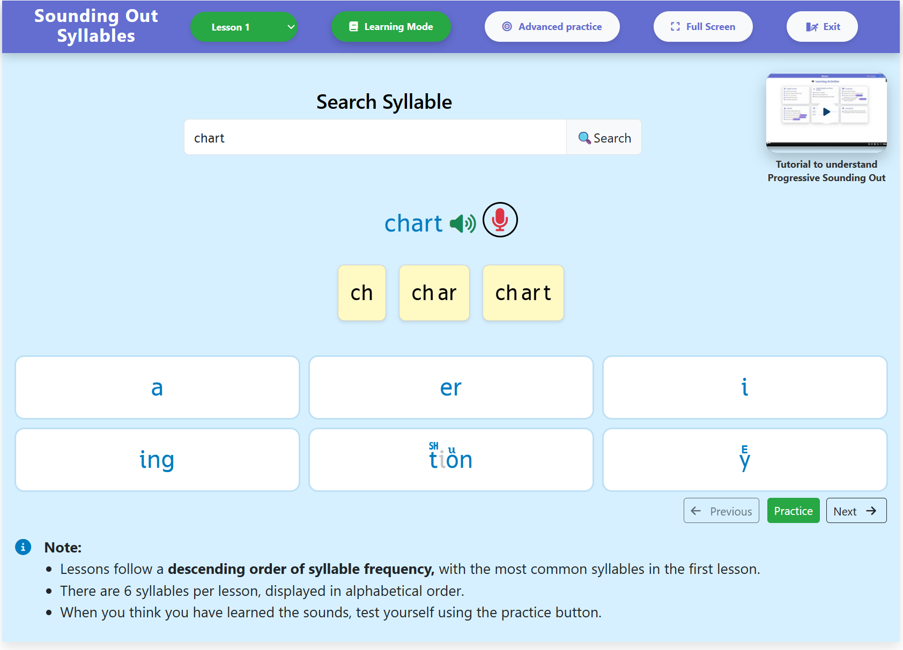
At each stage, the learner combines the sound already assembled with only one new phoneme. The completed sound is heard immediately, so the child is not required to retain several disconnected sounds in working memory and blend them all at the end.
Why Learning Syllables Is Highly Efficient
FE applies progressive sounding out to every syllable. Longer words are divided into syllables, each syllable is sounded out progressively, and the completed syllables are then combined into the whole word.
Syllables are highly efficient learning units because they are short and reusable. Learning a complete word helps a reader recognise that one word. Learning a common syllable can help the reader decode many different words.
As familiar syllables accumulate in long-term memory, less of each new word is genuinely unfamiliar. A reader may recognise most of a word immediately and need to sound out only one new syllable.
An analysis of 26,125 marked-up words in the FE database found that a learner who knows the 100 most common syllables and can sound out one unfamiliar syllable when needed has the components required to read 13,557 different words—more than half the words analysed. With 300 common syllables, coverage rises to 18,900 words, or about 72 per cent of the database.
This is very different from memorising 100 complete words. Those remain the same 100 words. One hundred reusable syllables provide building blocks for thousands of words the learner may never have seen before.
From FE to Standard English
The purpose of sounding out is not to make readers decode every word forever. It is to turn unfamiliar words into sightwords—words whose sound and meaning are retrieved automatically when they are seen.
Each successful decoding strengthens the connection between:
- what the word looks like;
- how it sounds; and
- what it means.
Children do not first learn an FE word and then have to learn a different standard-English word. FE preserves every character, its order and the word’s overall visual form. When the added pronunciation information is no longer needed, the same written word remains.
The transition is automatic:
Support That Can Step Out of the Way
The Fonetic English eReader provides this assistance within meaningful stories and informational texts. Readers can hear words and syllables, follow progressive sounding out and access vocabulary support when needed. Reading material can also be matched to a learner’s age, interests and current reading ability.
Familiar words can be read automatically, while FE remains available for unfamiliar words. As the learner’s store of familiar syllables and sightwords grows, reliance on the additional information naturally decreases.
FE is designed to give struggling readers the missing information, reduce unnecessary demands on working memory and help them experience successful reading. As decoding becomes automatic, attention can move from working out individual words to understanding ideas, enjoying stories and learning independently.