Research Paper by John Sweller and Chris Stephan
-
How Fo√ne…tic √Ēng…lish Applies Human Cognitive Architecture and Cognitive Load Theory
- Human Cognitive Architecture
Prof David Geary of the University of Missouri, a cognitive developmental and evolutionary psychologist, first used the term "Biologically Primary Learning" to describe information humans have evolved to effortlessly learn without instruction, and "Biologically Secondary Learning" to describe information that humans need to learn for societal and cultural reasons but are unlikely to learn unless they are explicitly taught and make a conscious effort to learn.
The discrimination of Biologically Primary and Biologically Secondary Learning indicated the need for instruction to be directed at biologically secondary rather than primary information.
Provide your email address to download the Cognitive Load Theory document
- Biologically Primary Learning
Humans have evolved to learn a number of complex skills without being taught, including:
- 1. Language Acquisition: Children learn to speak and understand their native language(s) without formal teaching. The ability to communicate orally is a fundamental biologically primary skill.
- 2. Walking and Running: Babies learn to walk and eventually run without any formal lessons. The process involves trial and error, but it's a skill we all develop.
- 3. Social Interaction: Understanding social cues, empathy, and cooperation are essential skills that humans pick up through observation and interaction with others.
- 4. Recognizing Faces: We can recognize familiar faces effortlessly, even without conscious effort. This skill is crucial for social bonding and survival.
- 5. Spatial Awareness: Our brains naturally grasp spatial relationships, allowing us to navigate our environment, estimate distances, and avoid obstacles.
- 6. Imitating Movements: We learn by observing others. Whether it's talking, dancing, playing sports, or mimicking gestures, imitation is a powerful learning mechanism.
- 7. Fear Response: Fear and danger detection are hardwired into our brains. We instinctively react to threats, such as jumping away from a sudden loud noise.
- 8. Object Permanence: Babies learn that objects continue to exist even when they’re out of sight. This understanding is crucial for cognitive development.
- 9. Recognition of Objects and Shapes: Humans and other primates have evolved to be able to almost instantly recognize complex shapes. For example, monkeys that have never seen a snake will react with fear to an image of a snake or other predator. This ability to recognize shapes of words in different fonts is a core skill that is employed in reading, discussed below.
- 10. Ability to be explicitly taught: For humans to survive, they needed to pass onto their offspring their knowledge about how to survive. Humans have evolved to both teach and be taught. Humans have been able to teach other humans an astonishing amount of information. A core part of a child’s early knowledge acquisition is learning the names and functions of objects. Some names appear to be picked up as part of a child’s language acquisition, but over time, the names of objects need to be explicitly taught.
- 10. Ability to be explicitly taught: For humans to survive, they needed to pass onto their offspring their knowledge about how to survive. Humans have evolved to both teach and be taught. Humans have been able to teach other humans an astonishing amount of information. A core part of a child’s early knowledge acquisition is learning the names and functions of objects. Some names appear to be picked up as part of a child’s language acquisition, but over time, the names of objects need to be explicitly taught.
- 11. Problem solving: Humans have evolved to solve problems by trying multiple scenarios (often mental scenarios) and seeing if one or more scenarios provides or is likely to provide the desired result.
- 12. Ability to Remember Things that Make Sense: Humans have an ability to quickly and easily remember things that make sense. This process is closely related to learning or understanding. But a precondition is the acquisition of concepts and the ability to problem solve that allows a person to “make sense” of something new.
- 13. Ability to focus on a small number of relevant issues: Humans have evolved the ability to learn what is relevant, and quickly prioritize and focus on the most relevant factors when needing to think about how to respond to a situation.
- 14. Ability to Protect our Long Term Memory from Irrelevant or Random Information: Our long term memory is what humans need to navigate the world and our memory needs to operate quickly and accurately. So humans have evolved a filter mechanism where we don’t remember irrelevant or random information which could clog up our memories and slow them down. Information that does not make sense has a higher probability of being wrong, so it is not surprising that humans can better remember what makes sense that what does not make sense. Understanding these processes allows better educational design.
- 15. Improvement through Practicing: Humans have evolved to be able to improve their performance in a wide range of physical and mental areas by practicing. Psychologist Anders Ericsson developed a structured way to improve performance that can be used to improve learning outcomes. Practice can change our brains by the development of new neural pathways that will allow e.g. fluent reading, accurate auditory discrimination of phonemes not in a student’s native language etc.
- 16. Ability to Cooperate in Large Groups: Most humans live peacefully in groups that are larger and much more complex than any of our primate relations.
- 17. Trusting the familiar and fear of change: A band of hominids in Africa is on the move and encounters new environments. At first everything is potentially dangerous. Repeated exposure to some things in new environments without negative consequences means that the hominids stop focusing on these things as imminent threats, and put their vigilance onto other things, which is a sensible strategy as focus is a limited resource. This describes an evolutionary understanding of how humans can be influenced by advertising and propaganda, and is one reason why humans often fear change. There is no need to explicitly teach things that we have evolved to learn without teaching.
- Biologically Secondary Learning
Anything that we need to learn but have not explicitly evolved to learn without instruction must be taught with instruction.
In particular, learning a second language and learning to read and write must be explicitly taught. Humans have evolved to learn to converse without explicit instruction, but mass reading has only happened in the last 2 centuries, and if reading confers a reproductive advantage, 200 years is far too short a time for any advantage to become apparent. Therefore, humans have not evolved to learn to read without instruction, and so reading must be explicitly taught. Some teachers saw that students learned the highly complex task of conversation in their native language and thought that if students can learn to talk with little or no instruction, then they should be able to learn to read with little or no instruction. However, this is not the case as humans evolved to converse but did not evolve to read. Reading and adult second language learning need to be explicitly taught.
Cognitive Load Theory hypothesizes that acquiring biologically secondary information happens best under conditions that are aligned with human cognitive architecture. For example, Cognitive Load Theory shows that explicitly teaching the information to be learned and then providing worked examples to study, is much faster than having a student trying to figure how to do what is being taught.
- Acquiring novel information
Students can learn either by problem solving or by obtaining information from others. Problem solving is very slow and inefficient while obtaining information from others is fast and efficient. Take Fonetic English for example. A student can learn Fonetic English in a few minutes. Fonetic English could have been used 1000 years ago but it was not invented until recently, in part because it needed a lot of scientific developments to become known for the overall system to be understood.
Although Fo√ne…tic √Ēng…lish took many years of development, it can be learned in just a few minutes. Clearly it is more efficient to have students learn an optimized system than having students try to develop it themselves.
- Processing and storing information
Humans have two kinds of memory:
1. Working memory, also called short-term memory that can only process 2, 3 or possibly 4 pieces of new information for as little as 20 seconds without the memory being refreshed.
2. Long term memory which can hold enormous quantities of processed information from working memory for long periods of time.
- Using information stored in long-term memory to govern action
Once information is stored in long-term memory, following appropriate signals from the environment, it can be transferred back to working memory to govern action. Unlike when dealing with novel information from the environment, working memory has no known capacity or duration limits when dealing with previously processed information retrieved from long-term memory. In this manner knowledge transforms us.
- Understanding Cognitive Load Theory
- Introduction
Cognitive Load Theory (CLT) is an experimentally based instructional theory based on how our brain acquires new information which can be stored and used to govern subsequent action. When dealing with biologically secondary information which we have not specifically evolved to acquire such as learning to read, the theory emphasizes the importance of managing our working memory's limited capacity and duration to enhance learning. Once information has been processed in working memory and stored in long term memory, a person goes from a slow, effortful, and error prone problem solver who relies heavily on a limited working memory, to a faster, more reliable and accurate problem solver who can rely on information stored in a vast long-term memory.
The evidence from extensive experimental research shows that instructional materials and teaching methods should be designed to optimize the cognitive load experienced by learners to facilitate the transfer of information to long-term memory.
Cognitive Load Theory’s experimental research shows that any subject area that humans have not specifically evolved to learn, requires explicit instruction for efficient learning. This means that all the information a student needs to learn something is provided in a way that minimizes unnecessary working memory load and maximizes transfer of information to long-term memory.
Types of Cognitive Load
1. Intrinsic Load: This is associated with the inherent complexity of the subject matter and varies according to the learner's existing knowledge. Intrinsic cognitive load needs to be optimised.
2. Extraneous Load: This unnecessary cognitive load is created by how information is presented rather than the complexity of the content itself. Extraneous cognitive load needs to be reduced.
- Cognitive Load Theory Effects
These effects offer designers of educational software guidelines for the design of efficient and effective processes with high learning outcomes. All effects either optimize intrinsic load or reduce extraneous load.
1. The Redundancy Effect: Avoiding the presentation of the same information simultaneously in multiple formats can prevent unnecessary extraneous cognitive load and support better learning outcomes. The addition of any irrelevant information such as cartoons or music has the same effect.
2. The Split-Attention Effect: Information that needs to be understood together should be integrated into a single format to facilitate easier learning. For example, in a geometric diagram, if learners must search for the location of Angle ABC, an extraneous cognitive load will be imposed in comparison to an integrated statement and diagram.
3. The Worked-Example Effect: Demonstrating step-by-step solutions to problems reduces extraneous cognitive load compared to solving a problem oneself.
4. The Modality Effect: Requiring learners to both look at a diagram and read text may overload the visual channel compared to looking at a diagram and listening to text.
5. The Expertise Reversal Effect: Instructional strategies should evolve as learners' expertise grows. For example, instruction should shift from guided examples to problem-solving tasks with increasing expertise. Similarly, information that is essential for novices may be redundant for more expert learners and may need removing.
6. The Element Interactivity Effect: Extraneous cognitive load theory effects are more likely with information consisting of elements that interact with each other due to a high intrinsic cognitive load rather than consisting of independent elements that can be learned in isolation.
7. The Imagination Effect: Encouraging learners to imagine the application of concepts rather than restudy them can enhance understanding and retention. Imagining multiple elements increases intrinsic cognitive load and so if element interactivity is too high, imagining rather than re-studying will have a negative effect due to the expertise reversal effect.
8. The Goal-Free Effect: Providing learners with open-ended problems such as, for example, calculating the value of as many variables as possible, reduces unnecessary cognitive load by eliminating problem-solving strategies that impose a high cognitive load.
9. The Completion Effect: Partially completed problems can guide learners through the learning process, offering a balance between guided instruction and active problem-solving.
10. The Variability Effect: Exposure to a wide range of problem types and contexts builds flexible knowledge and application skills. The effect only occurs if sufficient working memory capacity is available to allow the increase of intrinsic cognitive load associated with this effect. If sufficient working memory capacity is unavailable, a reverse effect will be obtained.
11. The Transient Information Effect: Some forms of information such as spoken text or animations are transient and so can unnecessarily increase extraneous cognitive load. Element interactivity must be sufficiently low to allow transient forms of information presentation to be effective.
- How Fo√ne…tic √Ēng…lish applies Human Cognitive Architecture and Cognitive Load Theory
- How Reading Repurposes Parts of the Brain
Humans have not evolved to read, so reading must be explicitly taught to students. There is no reading part of the human brain. Instead, several different parts of the brain must be repurposed to enable reading, but these parts need to be connected with new or enhanced neural pathways to provide the processing speed required for reading. To read at conversational speech speeds, these new neural pathways need to become very fast, which is achieved by the pathways being coated with a substance called myelin. A person’s brain will change physically as the person learns to read: it gets heavier as more myelin coats the neural network connections. The only way to myelinate these pathways is through practice: every good reader has practiced reading a lot.
- Silent Reading
Silent reading is repurposing the speech part of the brain to “hear” and understand the sound of unspoken words in the mind. Because reading repurposes the speech part of the brain, and the speech part of the brain has evolved to understand speech, it is not surprising that reading at the speed of spoken conversation, called fluent reading, enables significantly higher comprehension than slower reading.
Readers do not have time to decode the sound of individual words to read at the speed of spoken conversation. This means that readers need to see a word and instantly know its sound. A word a reader can recognize in this way is called a sightword and this fast reading process is called reading by sight.
Silent reading became possible only about 1200 years ago when Carolingian monks added spaces between words, punctuation and lower case characters to make the identification of a word much easier. Prior to that, words were in capitals with no word spaces and no punctuation. The recognition of individual words was slow and difficult, and required the reader to scan the line of characters, possibly multiple times, to identify individual words.
Here is some text as it would have been shown in Roman times:
HISEYESOPENWIDEASIFINSHOCKHESSAD
Here are the same characters with added information to help readers quickly identify words word: spaces, punctuation, and upper and lower case letters.
His eyes open wide as if in shock. He’s sad.
Words formatted with this additional information are much easier to read.
- The Key to Fluent Reading
The key to fluent reading is to quickly learn a large number of sightwords so that when you see a sentence, you can look at the words in sequence and instantly “hear” in your mind the silent sound of each word that you are looking at.
Learning sightwords requires some repetition. The question discussed below is how to best use Human Cognitive Architecture to minimize the required repetition.
- The Lack of Information in English Spelling
Phonetic words can be sounded out letter by letter with no rules or exceptions. This means that there is enough information in the spelling to allow a reader to decode the single, correct sound of the word just by using the spelling.
A partially non phonetic language means that a reader cannot accurately decode the single, correct spelling of non phonetic words in that language. This means that the non phonetic language does not contain enough information to enable a student to accurately decode the sound of all words just looking at the spelling.
It should come as no surprise that asking students to decode the sound of a written word will almost certainly result in poor learning outcomes if the students are not given all the information they need to decode the sound of that written word accurately and uniquely.
- Information needed to sound out English words
Linguists have known for well over 100 years the information needed to accurately sound out an English word:
1. The sound each character makes, including silent characters
2. Where the syllable breaks are: bâkeď vs √nâ…ked
3. Which syllable is stressed for the correct pronunciation and meaning:
√con…tract (a document) vs con√tract (get smaller)
There are 42 phonemes in English and 26 characters, so English characters make more than one sound. This can yield a staggering possible number of sounds a word can make.
Take the word “signed” for example. S can make 5 sounds, i can make 6 sounds, g can make 4 sounds, n can make 2 sounds, e can make 5 sounds and d can make 4 sounds. Both “g” and “e” can be silent (2x2 possibilities). Signed could be a 1 or 2 syllable word (2 possibilities), and the syllable break could occur in 2 places (2 possibilities). Multiplying the possible sounds together to get the total possible sounds yields the word “signed” can make is: 5x6x4x2x5x4x2x2x2x2 = 76,800!
- The Information Strategy of Fo√ne…tic √Ēng…lish
The information strategy used by Fo√ne…tic √Ēng…lish to teach a partially non phonetic language like English is:
1. Test each student to determine which phonemes or sounds of English characters and digraphs a student knows and can accurately discriminate, and the sounds of which characters and digraphs the students does not know and needs to learn,
2. Teach each student to accurately discriminate the English phonemes or sounds that the test has shown the student cannot accurately discriminate, and associate these phonemes or sounds with Fo√ne…tic √Ēng…lish characters,
3. Embed ALL the necessary information to enable students to sound out each word letter by letter with no rules or exceptions, and, at the same time,
4. Maintain the spelling of the English words, so that when students learn the shape and sound of a word (called a sightword), the students will be able to read normally printed text in standard English, so the reader will not depend on having marked up text to be able to read standard English
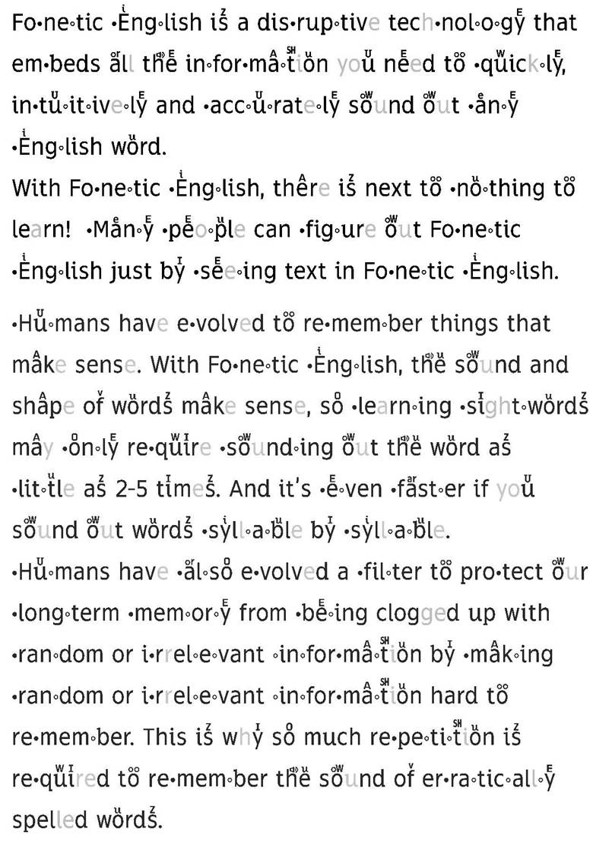
- Fo√ne…tic √Ēng…lish mark up has been specifically designed to simplify decoding the sound of English words.
1. Syllables and words can be sounded out letter by letter with no rules of exceptions.
2. The sounds that characters make when they do not make their usual sounds, are shown as superscript characters, which are known to the reader, so there is almost nothing to learn.
3. Stressed and unstressed syllables are marked and
Silent characters are greyed out.
- Fo√ne…tic √Ēng…lish rules
√bűş…ý
frñit
√bū…rý
qüick
ůşe
pùt
√än…ý
tңem
√dou…Εle
√â…Εle
yoů
- Letters with no superscripts make their usual sound
- Greyed out characters are silent
- Letters with superscripts make the superscript sound
- Capitalized vowel superscripts say their name: ý makes the sound /ee/ as in “see”, “you” becomes yoů
- Stressed syllable breaks are shown as √ and unstressed syllable breaks are shown as …
- ō and ù make the sound “oo” in “foot” and “u” in “put”, and tң is voiced
- The superscript “u” over a consonant (√dou…Εle, √â…Εle) adds the “u” sound to the syllable (√dou…bul, √â…bul)
- Fo√ne…tic √Ēng…lish Word Mark up
1. Spelling of English words do not change
Many words marked up using the International Phonetic Alphabet are not restricted to using just the letters which spell the English word. In some well know dictionaries, the word “example” is spelled as “ig√zam…pul”.
Fonetic English words are required to have the same spelling as the English words, which means that no letters can be added or removed. This means that the IPA representation of the sound of “example” is not permitted.
As a result, new compound characters (letters with superscripts) need to be created so that the word spelling of the word “example” is unchanged as in “∞√ŵam…ဇle”, pronounced as “ek√zam…pul”.
Approximately 70 compound characters were created to maintain both an accurate representation of the sound of the word and the English spelling.
2. Simple syllabification rules
A single syllable word is not stressed. Every word with 2 or more syllables has a single stressed syllable. Secondary stresses are not marked as they increase complexity for little gain.
3. Marking up words for meaning
In addition to accurately showing the sound of a word, Fonetic English words have been marked up to help convey the meaning of the word as well as the sound. Take the word “parking” for example, which is marked up as “√park…ing so that readers understand that the root of the word “parking” is “park”, with the addition of the suffix “ing”. In many dictionaries, the word “parking” is marked up as “√par…king” because this is how a lot of people pronounce the word. However, readers seeing the word “√par…king” could be confused as to the meaning of the word: they might think that the first syllable “par” is a suffix that somehow qualifies the noun “king”, which is neither correct nor helpful.
4. Prefixes, Suffixes and Syllable Recognition
Fonetic English aims to make syllable recognition as simple as possible as the benefits of syllable recognition for learning the meaning of words outweigh the benefit of making the sound slightly more accurate, as can be seen in “parking” example above.
In particular, prefixes and suffixes are marked up so they can be easily identified by readers.
5. Homographs are spelled differently
Homographs like wind (a breeze) and wínd (as in wind a clock), which have different sounds, have different Fonetic English spellings to reflect the different sounds of the words with the same English spelling.
6. Only one pronunciation of each word
Although some English words can be correctly pronounced in different ways, Fonetic English will select just one pronunciation of the word, which typically will be the most common and/or the simplest pronunciation.
7. Simplest pronunciation is preferred
Where there are 2 different ways a word is pronounced, Fonetic English will choose just one, which will generally be the simplest to pronounce.
The name of the letter U, which is the same sound as the word “you” or “yoo”, is written as “ů” in Fonetic English – a capitalized vowel superscript says its name.
We know from the IPA that the name of the letter U (or the sound of the word “you”), is made up of two sounds: “y” then “oo”. Some foreign language speakers find it hard to pronounce the letter “y”. It is not surprising that these people find it harder to pronounce the compound sound “you” than to pronounce the single sound “oo” as in “too”.
The word “allure”, which has 2 pronunciations. The simplest pronunciation is “u√loor”, spelled “á√llñre” in Fonetic English, has just the single sound “oo” as in “too” for the letter “u”.
In the second pronunciation, the letter U says its name, and the word is pronounced “u√lyoor”, or “á√llůre” in Fonetic English. Because some students find the sound “you” or “ů” more difficult to pronounce than “oo”, the first, and simpler, pronunciation of “allure” has been chosen.
The Fonetic English spelling of “allure” is therefore “á√llñre”.
8. Mark up to suit Text to Speech Engines
There is a trade off between the mark up complexity and the fidelity of the pronunciation from AI based Text to Speech (TTS) engines. In particular, the use of the schwa was limited but some instances of the schwa needed to be reintroduced for a better pronunciation of some words by Text to Speech systems.
9. The Fonetic English Font
The Fonetic English was developed by Fonetic English staff and Wayne Thompson, the Type Designer at Australian Type Foundry, www.atf.com.au, who not only created the actual font, but also provided valuable advice and expertise.
The Fonetic English font has been designed so that both individual Fonetic English characters and compound Fonetic English characters (characters with superscripts) are easy to visually discriminate.
The individual Fonetic English characters have all been designed to look different. For example, the characters “I”, “l” and “i”, and the characters “U” and “u” have been designed to be easy to visually discriminate. The characters “b”, “d”, “p” and “q” have been designed so that none of these characters is an exact mirror image or rotational image of another character.
As there is no character in the English alphabet for the sound of “oo” in “foot”, “u” in “put” and the voiced “th”, new symbols were added:
1. A speaker over the “h” indicates that the digraph “tң ” is voiced as in “that”
2. The Greek letters sigma sigma \\ have been introduced as superscripts over the letters “o” and “u” to indicate the sound of “oo” in “foot”, “u” in “put”: fōot and pùt
Multiple designs of the compound characters were tested to develop compound characters that were easy to recognize and discriminate from other compound characters and from single characters.
This document is written in Fonetic English font.
10. Quickly Learning a Lot of Sightwords
Learning a lot of sightwords is the key to fluent reading and better comprehension. Sightwords can be learned by
1. Repeated repetition – seeing the word and hearing its sound. This may take 20-50 repetitions, which is boring and does not work very well. Humans have evolved a filter to preserve our long term memory from information that does not make sense. If the spelling and sound of the word do not make sense, remembering the shape of the word and its sound may take 50 or more repetitions.
2. Sounding out the word letter by letter with no rules or exceptions. This may take as few as 2-5 repetitions because the sound and the spelling DO make sense. a. Because over 50% of English words are non phonetic exceptions, a large number of sightwords in English must be learned by rote, which is less effective than sounding out phonetic words. b. Literacy rates reflect this problem: literacy rates in English speaking countries are much lower than literacy rates in countries with phonetic languages where words can be sounded out letter by letter.
3. Sounding out words syllable by syllable. “black” and “smith” are the two syllables that make the word “blacksmith”, so pronouncing a word is very simple: say the syllable sounds without a pause. When a student has learned to recognize syllables by sight – see a syllable and recognize its sound – the student can sound out words made up of these syllables very quickly and easily. And learning syllables is very efficient:
a. Syllables are short, so breaking words into syllables reduces cognitive load associated with sounding out a word
b. Once a syllable is learned, it is then stored in long term memory and the limits of working memory no longer apply to learned syllables
c. Learning a small number of common syllables will enable a student to sound out a large number of words that are made up solely of the learned syllables
d. If a new word is encountered, it is likely that some of the more common syllables will already be known, simplifying the task of decoding the sound of the new word
11. Learn Sightwords using Fonetic English, and Automatically Read in Standard English
Fonetic English allows readers to sound out a word letter by letter, or syllable by syllable, and learn the shape of the word and the sound with just a few repetitions. Fonetic English does not change the spelling or shape of a word, so the shape the reader learns using Fonetic English is the same shape when written in standard English.
Fluent reading is seeing the shape of a word and instantly knowing its sound. This skill has evolved from the need of humans to be able to recognize the shape of camouflaged predators, especially snakes. This highly developed shape recognition skill enables a reader to recognize a word in any font and even handwritten.

The colour of the snake is the same as the background, so it is the shape of the camouflaged snake that we can recognize. Humans have evolved to recognize camouflaged snakes in all sorts of different positions.
One application is reading. Once a reader can recognize the shape of a word by sounding out the letters in the word, that reader can use the evolved predator recognition skill to read that word no matter how the word is written. It can be printed normally, can be in a curly type, can be printed badly, or the letters can be handwritten, and it can still be recognized by its shape.
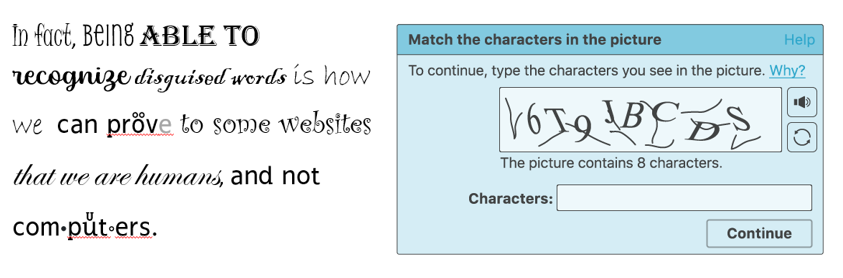
To summarize: a reader who has learned the shape of a word by sounding out the word in Fonetic English will also be able to recognize that word written in standard English, because the spelling and the shape of the word has not changed.
Thus there is an automatic transition from Fonetic English to standard English, and people who can read standard English can also read text marked up in Fonetic English.
12. Implications for Struggling Readers
In Italy, dyslexia is rarely diagnosed, but dyslexia is common in the UK. It was hypothesized that this might be genetic. Around 2000, the EU funded a project to look for the Anglo-Saxon dyslexia gene. About 1200 Italian students were subjected to standardized reading tests and the worst performing 18 were scanned using Positron Emission Tomography. These scans showed these 18 students were in fact dyslexic. What surprised everybody was that they could read well enough to get to university without specific reading interventions. The difference in the abilities of Italian and English dyslexics was explained by the differences in language: Italian is phonetic but many words in English are not phonetic.
Given that Fonetic English is phonetic, and that the Fonetic English font has been designed to make the visual discrimination of characters easier, it is hypothesized that Fonetic English will assist many struggling readers to improve their reading.
Additional new features that use the knowledge of Human Cognitive Architecture and Cognitive Load Theory are under development and will be explained in detail when these new features are released.
About the authors:
Chris Stephen is the Founder of Fonetic English. He has a BSc (Physics and Maths), BEc and LLB from the University of Sydney. He has been working in the accessible publishing area for over 20 years and is the holder of more than 10 patents.
Prof John Sweller is Emeritus Professor of Educational Psychology at the University of NSW and is one of the originators of Cognitive Load Theory: https://www.unsw.edu.au/staff/john-sweller