Here is why English is so hard to read — and how Fo√ne…tic √Ēng…lish fixes it
Your brain has evolved to remember what makes sense and to forget what doesn't. In a phonetic language a written word makes sense the instant you sound it out — spelling, word shape and sound agree — so you can remember it after as few as 1 to 5 repetitions. That is how children in Finland, Italy or Spain learn to read in about six months, against two and a half to three years for English speakers.
English is information deficient. We marked up over 26,000 English words and searched the database: only one in four needs no markup — those words are already fully phonetic. The other three in four are information deficient — their spelling does not carry enough information to fully and accurately decode the sound. The brain cannot make sense of them, so each must be memorised by rote, with as many as 20 to 50 repetitions needed for the word to be remembered. This is why literacy lags across the English-speaking world.
Fo√ne…tic √Ēng…lish adds the missing information. It marks each letter's sound, shows the silent characters, the syllable breaks and the stressed syllable — all without changing the spelling or the shape of the word. English spelling now makes sense, so you learn a word's shape and sound in as few as 1 to 5 repetitions, not the dozens that rote learning demands. This is a massive saving of time and energy, and significantly reduces frustration.
You don't have to learn whole words — you can learn syllables
Words are built from syllables. Black + smith, said without a pause, is blacksmith. Common syllables are used in many different words. Learn the common syllables once and you hold the building blocks of most of the language. Syllables are tiny: the 100 most common average just over two sounds each, quick to learn and endlessly reused.
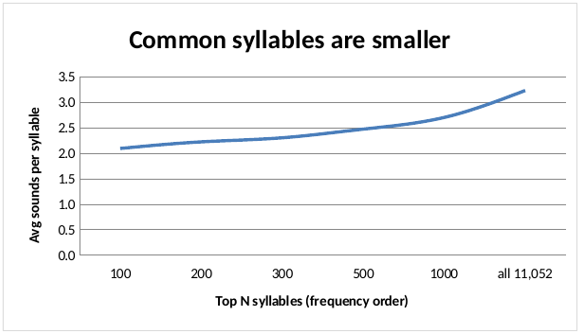
The syllables learned first are the smallest of all — the 100 most common average about two sounds each.
Fo√ne…tic √Ēng…lish has developed a tool to teach the sounds of syllable and how to decode the sounds of syllables.
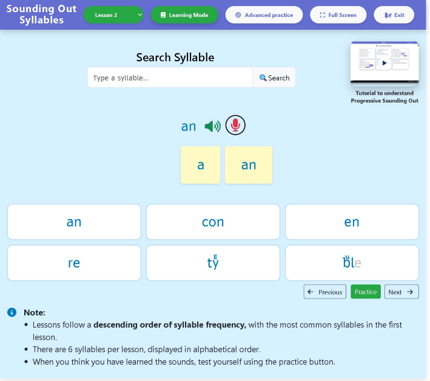
The Sounding Out Syllables tool teaches the common syllables in order of how often they appear, six per lesson
Fo√ne…tic √Ēng…lish mark-up makes syllables easy to recognise. Prefixes and suffixes are syllables at the start and end of a word that change the meaning of a root word. Fo√ne…tic √Ēng…lish has a comprehensive list of them, and learning a small number of prefixes and suffixes significantly expands a student's vocabulary with little additional effort..
The more syllables you already know, the faster a word becomes a sightword. If you recognise most of the syllables in a word, almost all of it is already familiar — there is little left to learn, so the word is remembered in a repetition or two. Fo√ne…tic √Ēng…lish also places its syllable breaks to keep root words whole. Take parking: dictionaries often split it par·king, which wrongly makes “par” look like a prefix on “king.” Fo√ne…tic √Ēng…lish breaks it park·ing — the root park kept whole, -ing as the suffix — so the word is easy to recognise.
The remarkable part
You almost never need every syllable in a word. Once you know the common syllables, the typical word has only one syllable you haven't met — and Fonetic English lets you sound that one out on the spot. Read the syllables you know instantly, work out the one you don't, and you can remember the whole word — its shape and its sound — in as few as 1 to 5 repetitions.
Here is what that means, from a full analysis of all 26,125 marked-up words:
How many of the 26,125 words can you read if you learned common syllables…
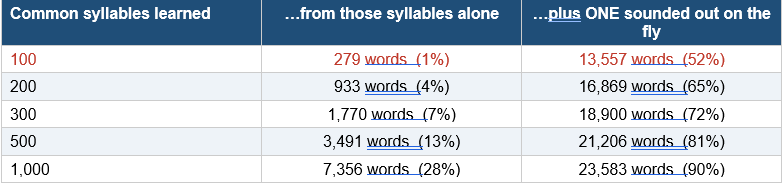
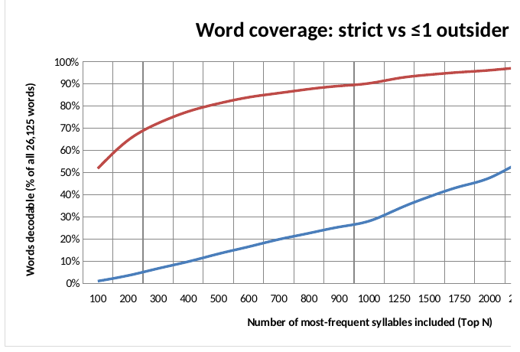
Word coverage rises steeply: with one syllable sounded out on the fly, the 100 most common syllables already unlock more than half of all English words.
Learn just 100 common syllables — these are small, averaging just 2.1 sounds each. If you can sound out one syllable on the fly, you can read 13,557 words: more than half of all the marked up Fo√ne…tic √Ēng…lish. Learn 300 and you reach 18,900 — nearly three-quarters. Nothing in ordinary English teaching comes close.
It is worth noting that the words that Fo√ne…tic √Ēng…lish have marked up include the CEFR words in A0, A1, A2, B1 and B2.
Why this is so efficient
Two things make the syllable approach far more efficient than learning words one by one.
First, syllables are reused. The same few syllables appear in word after word, so each one you learn keeps paying off. A word learned on its own teaches you nothing about the next word; a syllable learned once unlocks dozens of words.
Second, a syllable is far easier to sound out than a whole word. To sound out a whole word — even in a phonetic language — you must first work out where it divides and which letter-pairs are single sounds: is ar the one sound in art, or two sounds as in plan·e·ta·ry? You must hold all its sounds in mind at once, and place the stress. A syllable needs none of this: it is already the unit, it has just one vowel sound, and it sits comfortably within working memory.
The numbers show the gain. The 26,125 words contain 164,821 sounds — what a learner sounding out whole words must work through, word by word, with nothing carried forward. The same words are built from just 11,052 distinct syllables, only 35,804 sounds — learned once and reused everywhere. That is 4.6 times fewer sounds to learn, and the syllables you learn first are the smallest of all — the 100 most common average just 2.1 sounds each, against 6.3 sounds for a whole word and 6.9 for a typical multi-syllable word. The benefit is even bigger because you may need to sound out a phonetic word a few times before you remember it — whereas each syllable is learned just once or twice, and then used every time a word containing it is sounded out syllable by syllable.
Why fewer possible sounds means fewer repetitions
There is good evidence that the harder a word is to pin down, the more repetitions it takes to remember. Children learning phonetic languages such as Spanish or Finnish, where spelling reliably gives the sound, learn to read far faster than children learning English. And within English teaching, phonics — sounding words out — on average needs fewer repetitions than learning words whole by sight.
English spelling allows a startling number of possible pronunciations for a single word. Take signed. Following ordinary English rules, the letters could be sounded in around 76,800 different ways — each letter can take several sounds, some letters may be silent, the word could be one syllable or two, and the break could fall in different places. A learner facing that much uncertainty has a great deal to resolve, which is why it takes so many repetitions to settle on the right sound.
This is what sounding out really does: each part you can decode eliminates large numbers of those possibilities, narrowing the field. That is why phonics needs fewer repetitions than whole-word learning — it shrinks the uncertainty. But in ordinary English the shrinking is unreliable, because the learner cannot tell which parts decode correctly and which are exceptions — so a great deal of uncertainty remains, and many learners never get there.
Fo√ne…tic √Ēng…lish collapses the uncertainty to nothing. Every sound, every silent letter, every syllable break and the stress are marked, so signed has exactly one possible pronunciation, not 76,800. There is nothing left to resolve and no exception to guess at — which is why a word marked in Fonetic English can be remembered in so few repetitions.
This is an hypothesis, consistent with the evidence above and with our own results. It is also easy to test: it predicts that the fewer possible pronunciations a word has, the fewer repetitions are needed to learn it.
Then the training wheels come off
Silent reading repurposes the speech part of the brain to “hear” silent words in the mind, so it is no surprise that comprehension improves as your reading speed rises towards the speed you speak. This is called fluent reading. When reading at the speed you speak, you don't have time to decode written words — you need to see a word and instantly know its sound, which is called a sightword.
Once you can recognise a sightword by its shape and instantly know its sound, you no longer need the markup — you can recognise the shape of the word in plain English. The instant you recognise the word, you know its sound. Fo√ne…tic √Ēng…lish carries you to fluent reading, then steps out of the way.
Fo√ne…tic √Ēng…lish: learn sightwords fast with syllables, and then you can read ordinary English fluently.