A New Way to Teach Basic Vocabulary
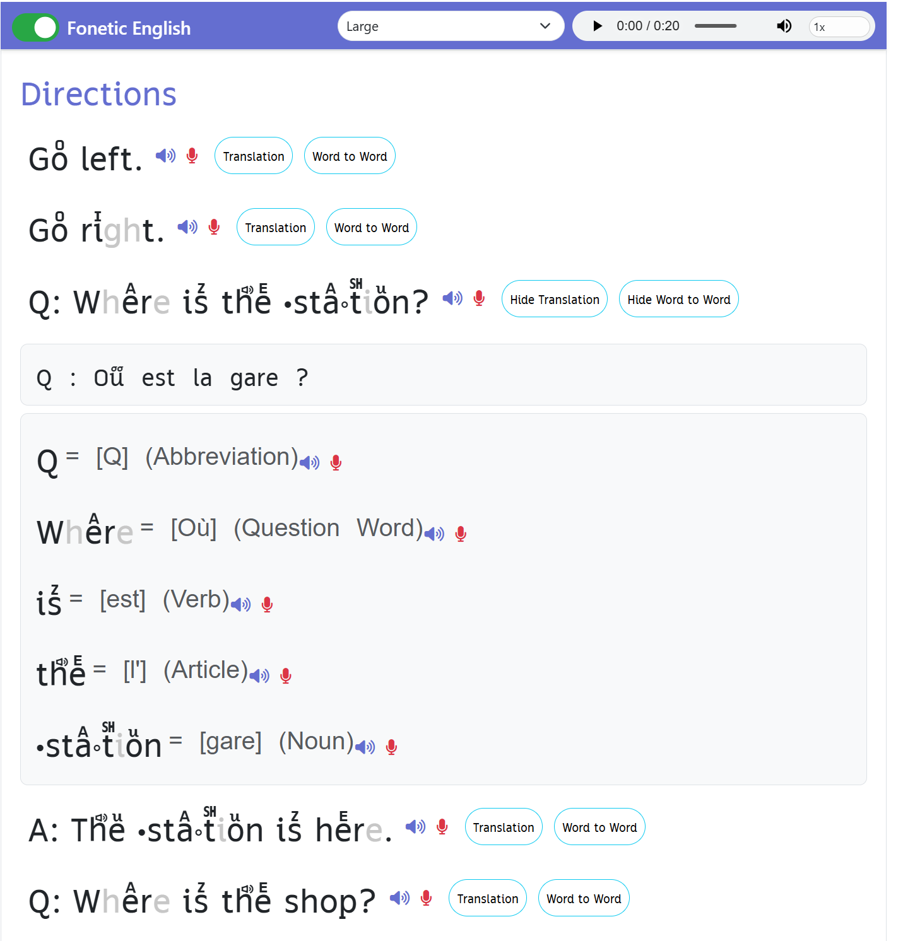
Instead of asking you to memorise lists of words, we give you useful sentences — the kind you are likely to hear and say in real conversation. Each sentence appears in Fonetic English markup, so you can see exactly how every word is pronounced. For each sentence, you can:
- Read it. Try to figure out the meaning of any new word from the words around it, then click the word to see its translation in your own language and check whether you were right.
- Hear it spoken by a native English speaker.
- Say it. Record yourself and compare your pronunciation with the model.
- Test yourself with a short quiz at the end.
Figuring out the meaning of a word for yourself — before you check — is what makes it stick.
You are not only learning vocabulary but also practising your reading!
Basic Vocabulary
Two levels
Basic vocabulary covers A0 and A1. Most English-speaking children will know the sound and meaning of these words. The sentences are short and simple, and are sentences a student is likely to hear. Sometimes a question comes with its answer. A student can hear the sentence read to them. A student clicks on a word and sees its translation. Intermediate vocabulary covers A2 to B2. The student works out the meaning from the context before being given it, and the different meanings of a word are taught. Advanced vocabulary is C1 and above and has not been produced yet.
A0 survival sentences
Every true beginner starts at A0. A0 vocabulary is taught through very simple survival sentences. The sentences are short, practical exchanges covering introductions, basic needs, directions, food, numbers and everyday communication. The sentences use only A0 words and are useful in real life straight away.
The sentences are written in Fonetic English, so a beginner can read them from the first lesson. A0 vocabulary also starts the student reading.
Hear, say and compare
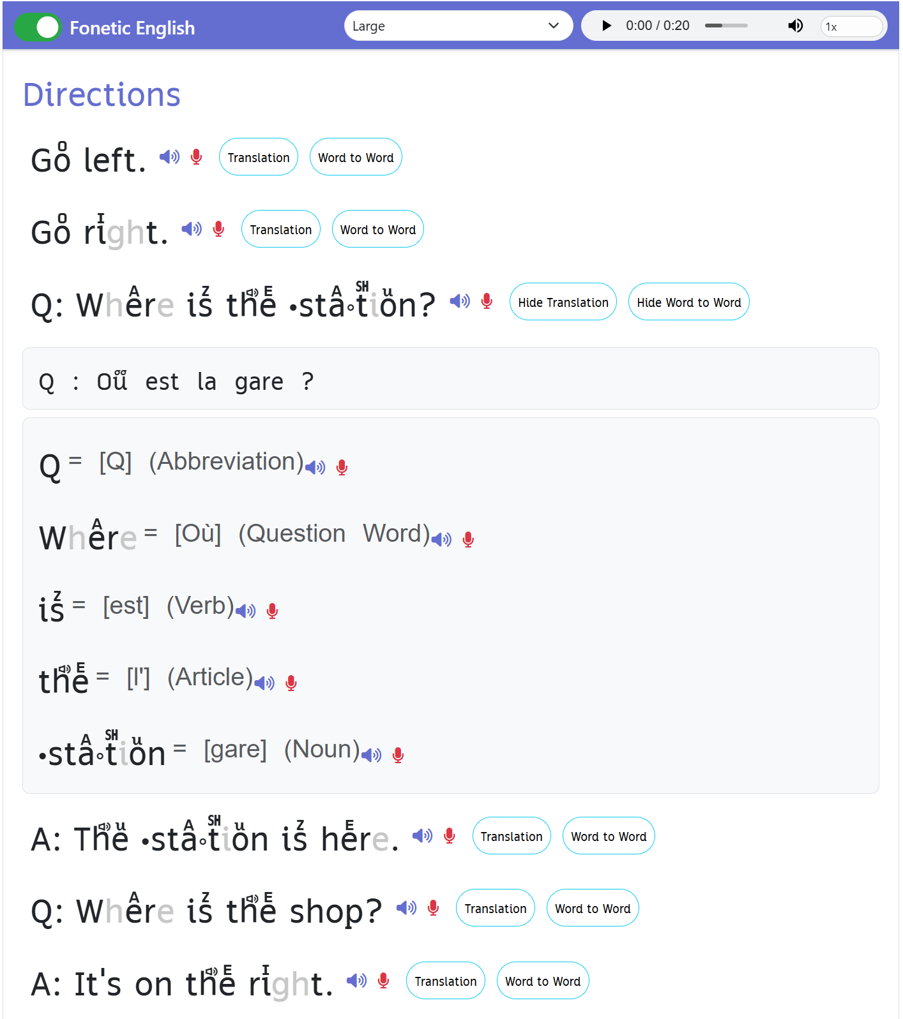
Every sentence has a speaker and a red microphone. The student listens to the sentence and records their own pronunciation, then compares the two. The whole lesson can also be played aloud, at a speed the student chooses.
Translation
For ESL students, translation is essential. Every sentence can be translated into the student’s native language as a complete sentence. Word to Word gives the translation of each word in the sentence, with its part of speech, and every word can be played and recorded.
The sentence translation gives the meaning that is correct for that sentence. Many words change meaning depending on context, so students should use the sentence translation wherever possible.
From translation to English only
Translation is available throughout Basic Vocabulary, at A0 and A1. Intermediate Vocabulary, from A2 onwards, has no translation. By A2 the student has enough English to work out the meaning of a word from two English sentences without falling back on their first language.
For tutors
Tutors can set Basic Vocabulary lessons as homework. Each lesson builds vocabulary, pronunciation and reading together.