Pillar 8 – The Scientific Principles applied by Fo√ne…tic √Ēng…lish
The fundamental scientific principle behind
Humans have evolved two different learning systems:
1. Biologically primary learning
- Speech and listening
- Facial recognition
- Social understanding
- Basic motor skills
- Ability to learn information and skills that are explicitly taught
These skills are learned effortlessly, without instruction. They develop naturally because humans have evolved neural mechanisms for them. Biologically primary learning does not rely on repetition — humans learn these abilities simply because we have evolved to learn them.
2. Biologically secondary learning
Anything humans learn that is not something we have evolved to learn is called biologically secondary knowledge.
These biologically secondary skills include:
- Reading
- Writing
- Spelling
- Academic vocabulary
Biologically secondary skills:
- Are not natural to the human brain
- Must be explicitly taught
- Rely on memory systems
- Compete with working-memory limits
- Do require repetition to consolidate
Why repetition matters for written words When learning written words:
- If the spelling system is phonetic and consistent, the sound, spelling, and shape of the word all make sense, so the word can often be learned in as
Fo√ne…tic √Ēng…lish Fo√ne…tic √Ēng…lish Fo√ne…tic √Ēng…lish w as 2–5 repetitions. - Because the brain’s evolutionary filters are designed to ignore random patterns, if spelling is irregular, inconsistent, or unpredictable, the brain treats it as random information, and may require 20–50 repetitions to overcome those filters.
The problem with English
English spelling is:
- Deep, irregular, unpredictable
- Filled with exceptions
- Poorly aligned with pronunciation
Therefore:
- Memory retention is low
- High repetition is required
- Students forget words easily
- Vocabulary development is slow
- Pronunciations fossilise incorrectly
What
- Making vowel sounds explicit
- Marking stress and syllables
- Identifying silent letters
- Revealing consistent patterns
Meaningful, structured words can be stored with as few as 2–5 repetitions, rather than the 20–50 repetitions often needed for irregular spelling.
This is the scientific reason
Supporting Scientific Principles Behind
The core evolutionary insight above is supported by several well-established research domains.
3. Cognitive Load Theory (John Sweller)
Irregular spelling creates unnecessary cognitive load because learners must:
- Guess pronunciation
- Memorise exceptions
- Manage unpredictable vowels
- Handle silent letters
- Cope with inconsistent stress
This allows working memory to focus on comprehension rather than guessing.
4. Explicit Instruction + Retrieval Practice (Roediger, Bjork)
Research shows that learning is strongest when the cycle is:
Explicitly teach → Test (Recall) → Correct → Spaced Practice
- Decode a word
- Recall syllables
- Recall stress
- Re-encounter words in later texts
- Cope with inconsistent stress
Because
5. Deliberate Practice (Anders Ericsson)
Deliberate practice is characterised by:
- Clear, specific goals
- Immediate feedback
- Repetition with refinement
- Gradually increasing challenge
- Model pronunciations
- Record-and-compare correction
- Step-by-step decoding
- Progressive exposure to more complex words
6. Neural Plasticity and Auditory Discrimination (Hebb, Merzenich, Kuhl)
Key scientific principles:
- “Neurons that fire together wire together” (Hebb)
- Adult auditory systems remain plastic and can reorganise (Merzenich)
- Learners reshape phoneme categories through structured exposure (Kuhl)
- /b/ vs /p/ (Arabic)
- /l/ vs /r/ (Japanese)
- /v/ vs /w/ (Hindi/Urdu)
- /ɪ/ vs /iː/ (Vietnamese)
7. Pronunciation as Motor Learning (Guenther, Flege)
Pronunciation is a motor skill involving:
- Lips
- Tongue
- Jaw
- Breath control
- Timing
- Providing model audio
- Allowing record-and-compare refinement
- Teaching prosody (intonation, rhythm, cadence, stress)
- Preventing incorrect motor patterns from becoming automatic
8. Fossilisation and the Importance of Early Feedback
Incorrect pronunciation becomes “locked in” if reinforced repeatedly.
- Giving the correct pronunciation at the first encounter
- Reinforcing correct syllable and stress patterns
- Allowing learners to compare their speech to a reference model
9. Fossilisation and the Importance of Early Feedback
In Italy, dyslexia is rarely diagnosed. In a research study published in 2001, researchers searching for an Anglo-Saxon dyslexia gene administered literacy tests to 1,200 Italian university students. The 18 students with the lowest scores were given PET scans, which showed that all 18 were dyslexic. What surprised the researchers was that these students had learned to read Italian well enough to reach university without any specific reading interventions.
This study demonstrates how a phonetic language like Italian can greatly assist dyslexic students to learn to read. Italian’s consistent spelling–sound system effectively compensated for dyslexic decoding weaknesses.
10. Sightword Formation (Linnea Ehri)
Sightwords form when spelling, sound, and meaning fuse into a single memory.
11. Morphology (Prefixes, Suffixes, Roots)
- Highlighting root families
- Making meaning connections visible
- Reducing the number of separate items students must memorise
Learners only need to learn the meaning of root words, as they have learned learned the meanings of prefixes and suffixes, and so can infer meaning of a root word with prefixes and suffixes, and remember these words quickly and easily. There are about 6,700 words to be learned for IELTS level 5, but there are only around 4000 root words that need to be learned, which can save the student a lot of time and effort.
Summary
The scientific foundation of
The brain stores structured, meaningful information easily — and filters out random information.
Meaningful structure requires as few as 2–5 repetitions; irregular spelling may require 20–50.
All supporting scientific principles — Cognitive Load Theory, retrieval practice, deliberate practice, neural plasticity, motor learning, dyslexia research, sightword formation, and morphology — reinforce this core evolutionary insight.
1. Biologically primary learning (natural learning)
Skills humans evolved to learn without instruction, such as:
- Speech and listening
- Facial recognition
- Social understanding
- Basic motor skills
- Learning through imitation and observation
These skills develop naturally because humans have evolved specialised neural systems for them2. Biologically secondary learning (explicit learning)
These include:
- Reading
- Writing
- Spelling
- Academic vocabulary
- Grammer
- Mathematics
These skills:
- Are not natural to the human brain
- Must be explicitly taught
- Use working memory
- Require repetition to memorize them
- Are highly sensitive to instructional design
Why this matters for English
When written words “make sense” (i.e., phonetic and consistent):
- They can be learned in as few as 2–5 repetitions
When written words appear random (irregular or inconsistent spelling):
- The brain’s evolutionary filters suppress them
- They may require 20–50 repetitions to learn
Irregular English word spelling does not contain enough information to be able to accurately decode the sounds of those words. Students have to find the pronunciation some other way. When students find the correct pronunciation, the sound, spelling and word shape usually does not make sense, so they need multiple repetitions to be able to remember it. elsewhere, or many overloads it because students must:
- Find out what sounds letters make when the letters do not make their usual sounds
- Handle silent letters
- Try to guess syllable breaks and which syllable is stressed
- Sometimes students will just guess the pronunciation because it is to frustrating to try find out the correct pronunciation
How
This transforms decoding from guesswork into structured processing.
Working memory is freed to focus on comprehension, meaning:
- Faster learning
- Higher accuracy
- Reduced frustration
- Greater long-term retention
CLT technique: Worked examples
FE provides a complete analysis of the sounds of any English word. Click on the speaker icon to hear the word pronounced as a word, syllable by syllable, and any syllable can be progressively sounded out. You can also compare your pronunciation to the reference pronunciation on the website.
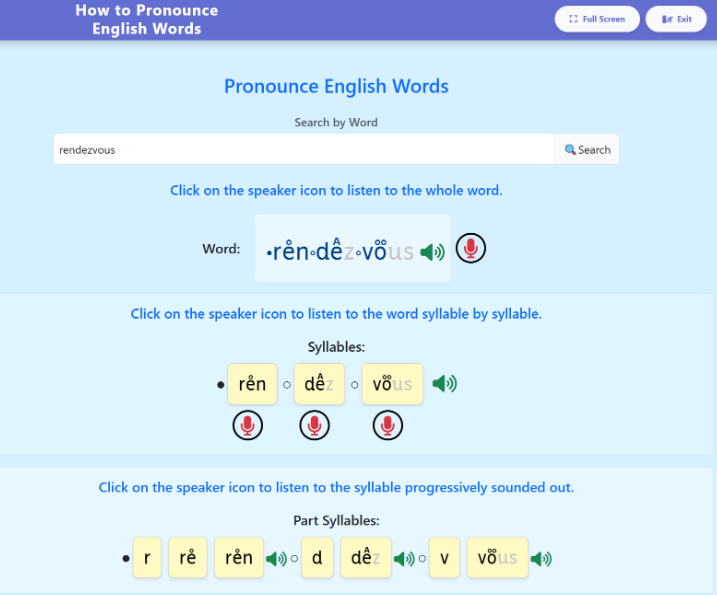
Providing examples is a core CLT method for reducing cognitive load and accelerating schema acquisition.
Explicitly teach → Test (Recall) → Correct → Spaced Practice
This approach produces:
- Stronger, longer-lasting memory
- Faster consolidation
- Better transfer to new contexts
How
Learners repeatedly:
- Recall the correct vowel sound
- Recall the syllable structure
- Recall the stress pattern
- Re-encounter the word in later texts
- Compare their pronunciation to a model
- Retrieve the meaning from morphology (prefixes/suffixes)
Because
- Specific goals
- Immediate feedback
- Repetition with correction
- Incremental difficulty
It is the engine behind expertise development in all complex skills.
How
- A clear goal: decode and pronounce the word
- Immediate auditory feedback
- Opportunities to record and compare
- Progressive complexity as learners move from simple to multisyllabic words
Every interaction in
- Neurons strengthen through repeated, meaningful activation (“neurons that fire together wire together”).
- Adults retain the ability to reorganise auditory pathways.
- Learners form “phoneme categories” based on their native language, which can distort new sounds.
It is the engine behind expertise development in all complex skills.
- /b/ vs /p/ (Arabic)
- /l/ vs /r/ (Japanese)
- /v/ vs /w/ (Hindi/Urdu)
- /ɪ/ vs /iː/ (Vietnamese)
How
- Making phoneme differences visible
- Reinforcing correct auditory categories
- Preventing ambiguous or misleading cues
- Providing consistent, precise models for imitation
This helps learners acquire English phonemes even when absent from their native language.
- Lips
- Tongue
- Jaw
- Breath
- Timing
- Resonance
This makes pronunciation a motor skill, similar to learning a musical instrument.
How
- Providing precise model recordings
- Allowing learners to record themselves and compare
- Showing stress, rhythm, and syllable boundaries clearly
- Helping learners refine their articulatory movements
- Preventing early development of incorrect motor patterns
- The learner practised the wrong sound
- There was no corrective feedback
- The sound was never contrasted properly
- The learner memorised an incorrect sightword
Once fossilised, errors are extremely hard to correct.
How
- The learner sees the correct pronunciation from the first exposure
- Silent letters are clear
- Stress is explicit
- Vowel sounds cannot be guessed incorrectly
- Learners receive immediate auditory comparison
In Italy, dyslexia is rarely diagnosed. In a research study published in 2001, researchers searching for an Anglo-Saxon dyslexia gene administered literacy tests to 1,200 Italian university students. The 18 students with the lowest scores were given PET scans, which showed that all 18 were dyslexic. What surprised the researchers was that these students had learned to read Italian well enough to reach university without any specific reading interventions.
This study demonstrates how a phonetic language like Italian can greatly assist dyslexic students to learn to read. Italian’s consistent spelling–sound system effectively compensated for dyslexic decoding weaknesses.
How
- The learner sees the correct pronunciation from the first exposure
- Silent letters are clear
- Stress is explicit
- Vowel sounds cannot be guessed incorrectly
- Learners receive immediate auditory comparison
Sightwords form when:
- Spelling
- Sound
- Meaning
- Ensuring correct pronunciation on every exposure
- Making spelling–sound connections clear
- Reinforcing consistency through repeated texts
Morphology (prefixes, suffixes, roots)
- Understand root families
- Infer meanings from the root word and the prefixes and suffixes, which reduces the number of root words to memorize
- Learn academic vocabulary faster