Want to get better English grades in less time, with less effort, and less stress, and save money?
Then read on…
Fo√ne…tic √Ēng…lish is a new, scientific way to learn English, giving you better results in less time, with less effort, less repetition and less stress, by incorporating principles of Cognitive Human Architecture and Cognitive Load Theory
“A series of brilliant innovations that will revolutionize language teaching”
UNSW Prof Emeritus
John Sweller, Founder of
Cognitive Load Theory
English spelling does not contain enough information for you to accurately figure out the correct sound of many English words
“signed can make
76,800” different sounds!
See the video to understand how this is possible
Fo√ne…tic √Ēng…lish provides yoů with āll tңê …in…for√mâ…ťiòn tȷ √qüick…lý dê√cõde √än…ý √Ēng…lish wòrd, and teaches yoů √Ēng…lish in a wây tңat wê √hů…mans have e√volved tȷ learn.
That's whΥ it works sõ well.
Fo√ne…tic √Ēng…lish Rules Can Be Learned In a Few Minutes
√bűş…ý
frñit
√bū…rý
qüick
ůşe
pùt
√än…ý
tңem
√dou…Εle
√â…Εle
yoů
- Letters with no superscripts make their usual sound
- Greyed out characters are silent
- Letters with superscripts make the superscript sound
- Capitalized vowel superscripts say their name: ý makes the sound /ee/ as in “see”, “you” becomes yoů
- Stressed syllable breaks are shown as √ and unstressed syllable breaks are shown as …
- ō and ù make the sound “oo” in “foot” and “u” in “put”, and tң is voiced
- The superscript “u” over a consonant (√dou…Εle, √â…Εle) adds the “u” sound to the syllable (√dou…bul, √â…bul)
- There! You just learned Fo√ne…tic √Ēng…lish
Fo√ne…tic √Ēng…lish helps you master 5 key English skills
1. Fluent reading
- √Rêad…ing iş √sêe…ing √writt…èn wòrdş, and √hê…ár…ing and …un…der√stand…ing tңê “√sí…lent wòrdş” yoů √hê…ar in your mínd. Yoů repurpose tңê spêech part o« your brâin, and yoů …un…der√stand best when yoů rêad at tңê sâme √num…ber o« wòrdş per minute aş yoů spêak. Yoů don’t have tíme tȷ dê√cõde wòrdş. When yoů sêe a wòrd, yoů nêed tȷ √in…stant…lý √re…cog…níze tңê wòrd bΥ its shâpe, and √in…stant…lý knõw its sijund and √mêan…ing, which iş called a sightword. Yoů nêed tȷ knõw a lot o« √síght…wòrds tȷ rêad at tңê râte yoů spêak. Sõ √learn…ing √síght…wòrds with Fo√ne…tic √Ēng…lish iş tңê fastest wây tȷ get gōod √rêad…ing scores in your IELTS test.
2. Knowing what English words mean
- Fo√ne…tic √Ēng…lish is pioneering new ways to optimize leaning the meaning of words.
3. Effortlessly recognize spoken English words
- You hear an English word and can recognize the word and know its meaning, all without thinking, so you listen like a native English speaker. This is the fastest way to get good listening scores in your IELTS test.
4. Speak in English and be easily understood
- Fo√ne…tic √Ēng…lish teaches you how to make English sounds, tells you exactly how each English word is pronounced, improving your pronunciation, and boosting your confidence. When you can clearly hear English, you can improve your own pronunciation by using our practice tools that record your pronunciation and compares your pronunciation to the pronunciation of a native speaker. This is the fastest way to get good speaking scores in your IELTS test.
5. Write better English
- You know the shape of a word and its sound, so checking the word looks right and sounds right will help you spell correctly. This is really important if you have to hand write test answers or if you are not allowed to use spell checkers, like when you are doing an IELTS test.
Learn the meaning of English words
You need to know what English words mean to be able to understand what you hear or read, and how you express yourself.
Fo√ne…tic √Ēng…lish makes learning the meaning of words (vocabulary) as easy as possible by optimizing how different word types are taught:
1. Images
- It is much easier to show an image of a square or a photo of a cat than it is to understand a written definition, so words like square and cat are taught with images
2. Translations
- If your native language is not English, then you can learn English words by seeing a translation of the word into your native language
3. Definitions
- you can use the Fo√ne…tic √Ēng…lish Dictionary which has been specifically designed to make it as easy to use as possible.
4. Prefixes & Suffuxes
- Learn the meaning of root words and then learn how the meaning of the root words changes by adding prefixes and suffixes (morphology).
5. Reading
- Reading will improve all aspects of your English skills including learning the meaning of words. Fo√ne…tic √Ēng…lish has designed a new type of eReader to help you improve all aspects of your English
Fo√ne…tic √Ēng…lish Dictionary
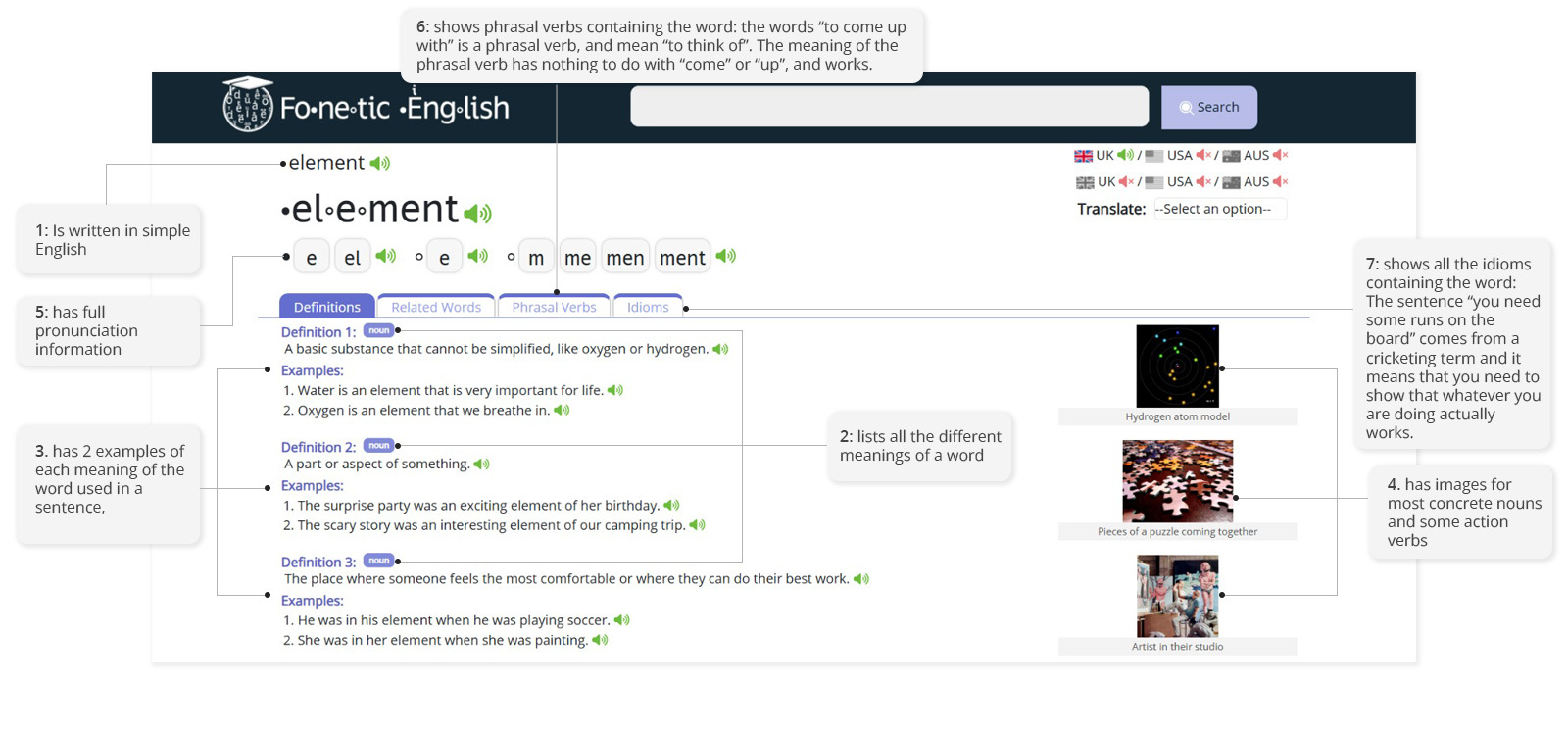
Fo√ne…tic √Ēng…lish eReader
- The Fo√ne…tic √Ēng…lish eReader has 4 ways it can display text:
Fo√ne…tic √Ēng…lish phrase format
- Standard English sentences are formatted as if they were in a book with additional features displayed when you click on a word:
- hear it pronounced in your accent of choice
- see what kind of word it is (part of speech)
- understand the approximate meaning of the word from its context which can teach you the meaning of the word
- see the word precisely translated into your native language – the word “star” has 5 meanings, but you will just be shown the translation of the meaning of “star” as it is used in the text you are reading, which teaches the meaning of the word
- if the word is part of a phrasal verb or idiom, then the phrasal verb or the idiom in English will be displayed together with a definition of what the phrasal verb or idiom means.
Fo√ne…tic √Ēng…lish book format
- this is the same as the standard English format with the words converted to Fo√ne…tic √Ēng…lish
English Phrase Format
- Standard English sentences can be broken into phrases and the key words in each phrase will be highlighted, which can make reading faster for both native and non native English speakers. Click on a phrase to display:
- A word by word translation of the phrase into your native language with parts of speech
- The translation of the phrase into your native language with the correct grammar and word order of your native language
- Grammar notes explaining the difference in your native language and English is English and in your native language
- Phrasal verbs and idioms will remain intact as phrases
Fo√ne…tic √Ēng…lish phrase format
- this is the same as the standard English phrase format with the words converted to Fo√ne…tic √Ēng…lish.
Listen like a native English speaker
When you can listen and effortlessly recognize English words without thinking, you will be able to focus on understanding what was said, so you will understand more.
The good news is that Fo√ne…tic √Ēng…lish makes learning effortless listening much easier because:
- You only have to learn English sounds that are NOT in your native language
- You may already know some missing English sounds
- You may already know some English sounds that are not in your native language, because these sounds are used in common English words, place names and brand names that you may have heard and already know. You will be presented with a list of common English words that you might know that contain the missing sounds.
- You may learn some English sounds more quickly if you learn to make the sounds
- Many non native English speakers find some sounds like “th” very difficult to hear and say. It’s easy to make the mouth movements to make the “th” sound, and when you make the correct mouth movements, you will hear the “th” sound and many people find this a quick way to learn the sound
- The trouble with “th”, “p”, “f” and “h” is that they are very soft sounds. Many people don’t think they are making the correct sound because they are so soft. [show videos of the mouth movements of th, p, f and h]. You need to pronounce these soft sounds followed by a vowel to hear them, and there are specific exercises to help you with this.
- Try learning syllables containing missing sounds before you learn missing sounds by themselves
- Fo√ne…tic √Ēng…lish can teach some missing English sounds by teaching you syllables that contain sounds you know (sound in your native language and in English), as well as a missing sound.
- For example, suppose the sounds, “c”, “o” and “t” are in your native language and “a” is not a sound in your native language. You will be able to hear “cot” as you can hear “c” “o” and “t” and you will be able to hear “cat” because you can hear “c” and “t”.
Learn the sound of ANY English syllable or word
Fo√ne…tic √Ēng…lish tells you exactly how a word is sounded out or pronounced so that you know what sounds to listen for.
Practice recognizing English sounds
- Fo√ne…tic √Ēng…lish provides you with tools that let you practice recognizing these sounds. You hear the sound of an English syllable or word, and you select the word that makes that sound. There may be more than one word with the same sound – same sound but different spelling. This exercise teaches you to
- Recognize the sound of the word as it is played, developing your listening skills
- Recognize the written word (or words) that make the sound, teaching you sightwords, and
- Gives you the sound and shape of the word, which helps you with spelling.
Speak English so you are understood
1. You don’t need to learn to pronounce English sounds that are in your native language.
- Fo√ne…tic √Ēng…lish will tell you which English sounds are in your native language, and how these sounds are spelled in your native language.
2. Voiced and unvoiced sounds
- The vowel /ê/ (/EE/) is a vowel that is in every language and is always voiced. Touch your voice box with your fingers and say /Ê/ (/ee/) and you will feel the VIBRATION of the voice box in your fingers. This vibration is what is meant by VOICED.
- All vowels are voiced.
- The consonant S is also in every major language and is always unvoiced.
- Touch your voice box with your fingers and say Ê and you will feel the vibration in your fingers. This is what is meant by VOICED.

- Here is an image showing the location of the voice box.
3. English vowels – all vowels are voiced
- Continuous single sound vowels:
- ê, oo, ur.
- Short Vowels, Single Sounds:
- A, e, i, o, u, ō, ù.
- Compound vowels:
- â, í, à, ů, ar, or, ow, oy.
- These sounds are made up of 2 or 3 other phonemes sounds. You are first taught how to make the individual sounds, and shown how these sounds make up the compound sound
4. Consonants
- Single Sound Continuous Consonants:
- l, r
- Single Sound Continuous Nasal Consonants:
- m, n, ng
- which are pronounced by send the sound out the nose.
- Voiced/Unvoiced Continuous Consonant Pairs:
- f/v, s/z, sh/zh, th/tң (voiced)
- These sounds pairs have the same mouth movements – the first sound is voiced and the second is unvoiced.
- Voiced/Unvoiced Short Consonant Pairs:
- p/b, t/d, k/g
- These sounds pairs have the same mouth movements – the first sound is voiced and the second is unvoiced.
- Soft Consonants:
- f, h, p, unvoiced th
- The mouth movements for these consonants are easy to make but they make very little sounds, so to hear them, you need to pronounce the soft consonant followed by a vowel. The soft consonants followed by every vowel have been recorded for you to hear.
- Compound Consonants:
- ch, j, w, x, y
- These sounds are made up of 2 or 3 other phonemes sounds. You are first taught how to make the individual sounds, and shown how these sounds make up the compound sound