Pillar 6 – What practice tools does Fo√ne…tic √Ēng…lish provide?
To speak English well, learners must master all 42 English sounds of phonemes and be able to quickly and easily decode the sound of any English word. To master all 42 phonemes, learners need practice hearing sounds, making sounds and decoding words.
- Reading practice materials – Graded reading texts written in
Fo√ne…tic √Ēng…lish markup let learners choose texts at their reading level, select texts they want to read, decode sounds directly, turn words into sightwords faster, and build fluency with improved comprehension. Inbuilt comprehension questions require active recall which boosts memory. Hints are provided so that students who answer incorrectly will be guided to the right answer and understand why it is the right answer. - The eReader app – Learners can click on any word to hear it pronounced slowly and clearly, and see a precise translation into their native language. This gives them the correct sound and meaning instantly when meaning from context is not obvious.
The word “information” in an eReader document has been clicked on, showing a speaker to hear “information” pronounced, the word “pronunciation” translated into Japanese, and the Part of Speech, a noun. - Dictionary with audio – Every word in the
Fo√ne…tic √Ēng…lish dictionary shows a simply written definition and two examples of each different meaning of the word, the sounds that letters make in that word, including letters that do not make their usual sound, silent characters, syllable breaks and stress, You can hear a slow, clear audio pronunciation of the word, the word pronounced syllable by syllable and each syllable progressively sounded out. Learners can practice their pronunciation right in the dictionary. This helps learners connect spelling, sound, and meaning in one step.

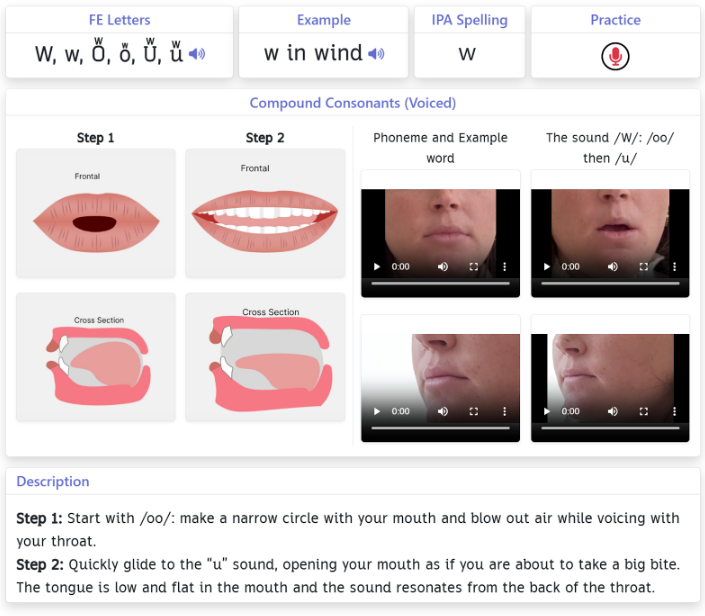
- Mouth-movement videos – These show how to position the tongue, lips, and jaw to make each of the 42 English phonemes, making difficult sounds easier to learn. Learners can practice making the sounds while looking at the mouth movement instructions.
- Cross-language phoneme maps and practice tools –
Fo√ne…tic √Ēng…lish has compared English phonemes to the sounds of other languages. Most languages have a significant number of sounds or phonemes that are in English, and students can already discriminate and pronounce these sounds and don’t need to learn them. Sometimes the common sounds have the same spelling, and there is a teaching tool for students to learn and practice the English spelling of these common words if the spelling is different. This focuses students to learn the sounds that are not in their native language. - Auditory-discrimination trainer –
Fo√ne…tic √Ēng…lish shows the sounds in a word, so learners know what to listen for, which makes auditory discrimination much easier. Have you heard a foreign language speaker say their name, and you couldn’t discriminate the sounds, but when they gave you a card with their name on it, you could discriminate the sound. Interactive exercises help learners hear the difference between similar sounds, improving listening skills and pronunciation. - Record-and-compare pronunciation tools – Learners can record their own speech, compare it to model pronunciations, and track improvement over time.
The
The
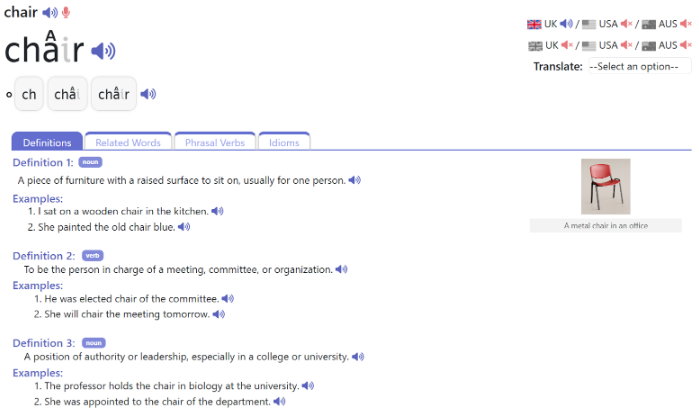
Each entry includes:
- Full
Fo√ne…tic √Ēng…lish markup — The sound of every letter in a word is clearly shown, even when a letter does not make its usual sound, and syllable breaks, stress marks, and silent letters are explicitly shown. This makes the sound of the word completely clear, even when ordinary spelling is irregular. - Audio support — Learners can hear each word pronounced slowly and clearly. They can also listen syllable by syllable, and even phoneme by phoneme. This reinforces how the word is built from sounds and helps improve both listening and pronunciation.
- Definitions and examples — Each word has simple definitions and at least two example sentences. This makes the meaning clear and shows how the word is used in context.
- Cross-language support — For learners who are not native English speakers, the dictionary can also provide a precise translation into their first language. This confirms the meaning when context is not enough.
- Pronunciation Practice – learners can practice right in the dictionary by recording their pronunciation of the word and comparing their pronunciation to the reference pronunciation on the website. The comparison tool will quickly alternate play their recording and the reference recording as many times as the learner needs to clearly hear the differences, and can self correct.
- Related words- English vocabulary is organised into
- families of related words that share a common root, such as act, action, active, react, actor, and activate. Recognising these relationships allows learners to infer meaning, reduce memorisation load, and understand how prefixes and suffixes modify words.
- In addition to root-based families, many English words form compound words, where two or more words combine to create a new meaning, such as sunlight, notebook, classroom, or supermarket. Compound words are especially useful for learners, because the meaning is often transparent once the parts are recognised.
Fo√ne…tic √Ēng…lish supports both word families and compound words by clearly marking pronunciation, stress, and syllable structure, making it easier for learners to decode each component accurately. By presenting these related forms in a structured way,Fo√ne…tic √Ēng…lish helps students store vocabulary as meaningful patterns rather than isolated items, greatly accelerating vocabulary growth and reading fluency.
- Phrasal verbs are combinations of a verb and a particle (e.g., turn off, look up, get over, break down) whose meanings are often not predictable from the individual words. They are one of the most challenging aspects of English because they behave like idioms: their meanings shift depending on context, tense, and even stress.
Fo√ne…tic √Ēng…lish assists learners by marking the pronunciation and stress of each phrasal verb clearly, helping students distinguish similar forms (e.g., take off, take up, take over).Fo√ne…tic √Ēng…lish also allows students to learn phrasal verbs as structured items rather than as random expressions, reducing the memory burden and helping learners master these essential but difficult forms of English.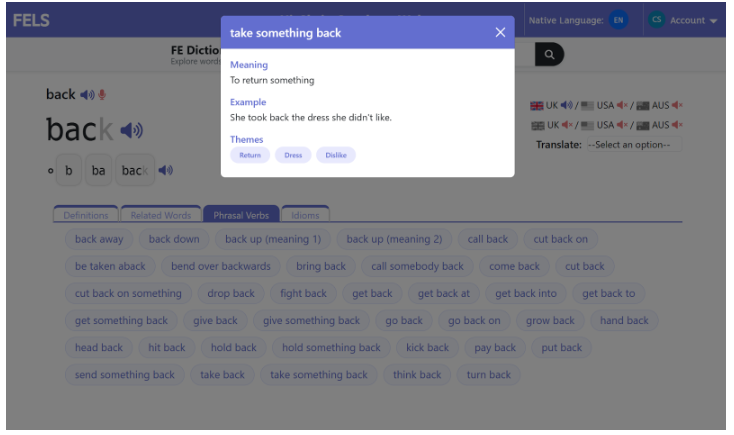
- Idioms are fixed expressions whose meanings cannot be deduced from the individual words, such as “spill the beans,” “hit the nail on the head,” or “once in a blue moon.” Because the meaning is figurative rather than literal, idioms can be confusing for learners, and pronunciation often carries important cues to tone, emphasis, and intent.
Fo√ne…tic √Ēng…lish helps by ensuring that learners can pronounce idioms clearly and naturally, with accurate stress and rhythm, so the expressions sound authentic and are easier to remember. By removing the difficulty of decoding irregular spellings,Fo√ne…tic √Ēng…lish allows learners to focus on understanding and using idioms correctly in real communication.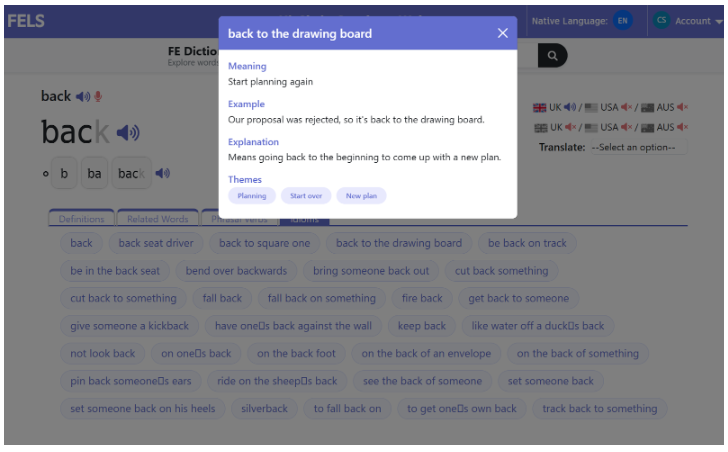
The result is a faster and easier path to fluency: vocabulary grows faster, comprehension improves, and learners build the confidence to read and speak in English.
The
1. Complete sound coverage — The app includes all 42 English phonemes. Each sound is taught with clear audio, mouth-movement instructions, and videos showing how to form the sound.
2. Progressive sounding out — Words can be heard as whole words, syllable by syllable, and phoneme by phoneme. For example the single syllable word “strengths” can be progressively sounded out as
Progressive sounding-out: there are just two pieces in working memory so even long syllables can be sounded out:
1. the blended sound so far, and
2. the next sound to add.
Worked example — the syllable “strengths”:
This shows that even the hardest-looking words can be decoded in small, manageable steps.
3. Syllable-based practice — Because most long words can be broken into 2–4 syllables, sounding them out syllable by syllable makes even complex words manageable. Learners quickly see that long words are not overwhelming.
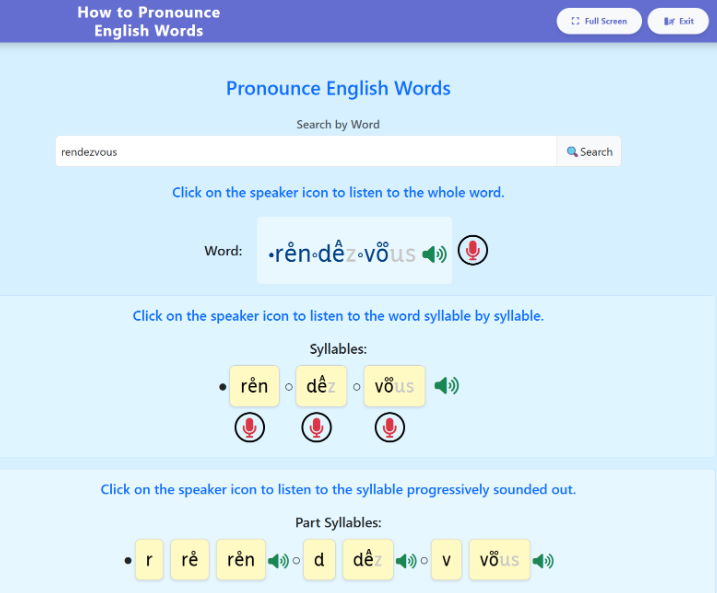
4. Record–compare–repeat — Learners can record their pronunciation of phonemes, syllables, or words and then compare it with the reference sound on the website. Playback alternates between the reference and the learner’s recording, sharpening auditory discrimination and improving accuracy.
5. Listening and comprehension gains — By repeatedly distinguishing similar sounds (like ship vs. sheep or thin vs. then), learners strengthen their listening skills. This helps them understand spoken English more easily in everyday situations.
Together, these tools allow learners not just to practise saying words, but to hear, discriminate, and remember sounds more effectively. Over time, pronunciation becomes clearer, listening comprehension improves, and learners gain confidence in both reading aloud and everyday speech.
Many people have had the experience of hearing a non-native speaker say their name and not being able to discriminate it clearly. But as soon as you see the name written down, you can suddenly 'hear' it accurately — because now you know what to listen for.
This linking of print and sound trains the ear to tell similar sounds apart more reliably. For learners, this strengthens listening comprehension, pronunciation accuracy, and overall confidence in both reading and speaking.
Mouth movement instructions are guides that show learners exactly how to shape sounds with the lips, tongue, and jaw.
For many learners, seeing what to do physically makes a big difference. Instead of trying alternatives blindly, you know precisely how to position your mouth to create the correct sound.
This also creates a positive feedback loop: if you struggle to discriminate a sound — for example, the English “th” — the mouth movement is simple. When you place your tongue correctly between your teeth and blow air, you hear yourself make the correct sound. Hearing your own accurate sound immediately strengthens your ability to discriminate it in others’ speech. The better you discriminate, the easier it becomes to self-correct and refine your pronunciation.
Learners can also record themselves and compare their pronunciation to the reference sounds provided in the
The “record and compare” tools give learners direct feedback on their pronunciation by comparing their recording to the reference recording on the website. The process is simple but powerful:
- Record — Learners speak a sound, syllable, or full word into the app.
- Compare — The app plays back the learner’s voice alternated with the
Fo√ne…tic √Ēng…lish reference, repeating until the learner stops it. - Hear the difference — Because the two recordings rapidly alternate, even small differences become clear to the ear. Learners quickly notice if their sound is too short, too long, or formed in the wrong place.
- Self-correct — Hearing the contrast guides learners to adjust their lips, tongue, or jaw until their sound matches the reference.
This cycle builds a positive feedback loop: improved discrimination makes self-correction easier, strengthens pronunciation, and in turn makes auditory discrimination even stronger.
For example, with the English th sound, many learners struggle to hear and produce it correctly. By recording themselves, placing their tongue between their teeth, and then comparing with the reference, they can both hear and feel when they get it right. This accelerates learning far more quickly than practice without feedback.
Over time, repeated use of record-and-compare tools helps learners speak more clearly, listen more accurately, and gain confidence in real conversations.
Every language has its own set of sounds, called phonemes. English has 42 phonemes, but many are not found in other languages. For example:
- Spanish does not have the English sh sound.
- Japanese does not distinguish between r and l.
- Many languages lack the English th sounds (as in thin and then).
When a sound is missing from a learner’s first language, it is much harder to hear and pronounce correctly.
- Identify the gap —
Fo√ne…tic √Ēng…lish cross-language phoneme maps show which English phonemes are present in your first language and which are missing. This helps learners and teachers target their practice. - Show common English starting with or containing the missing sound. English is used so widely that many people know borrowed English words, place names, brands etc that contain the missing English sounds. These are displayed to see if learners recognize any of the missing sounds.
- Practice recognizing missing sounds. A sound is played and learners must click on the
Fo√ne…tic √Ēng…lish letters that spell out the sound they just heard. The sounds that are played are syllables that have one missing sound and 2 or more sounds that are in both the foreign language and in English, so the learner will be able to recognize the syllable sound as it contains sounds they know and so can practice effectively. The next step is to hear syllables played with just one common sound and the missing sound, and then hearing the missing sounds by themselves. - Tongue twisters. Learners can practice with similar words that are hard to discriminate, such as “then” and “thin”, which will further improve their auditory discrimination skills.
- Show how to make the sound — Mouth-movement videos demonstrate exactly how to place the lips, tongue, and jaw. Seeing the movement makes it clear how the new sound is formed. When you can make the new sound, you will also be able to hear it, which creates a positive feedback loop.
- Practise with feedback — Learners record themselves producing the sound and compare it to the
Fo√ne…tic √Ēng…lish reference. The alternating playback makes even small differences obvious, so learners can adjust and improve quickly.
These tools — knowing what sounds are missing, recognizing missing sounds already knows, practicing recognizing the missing sounds using syllable containing common sounds, practicing with tongue twisters, seeing how to make the sound, and practicing pronunciation — ensures that learners will be able to both hear and produce new sounds accurately.
Over time, these once unfamiliar phonemes become part of the learner’s working sound system. That leads to clearer speech, sharper listening, and greater confidence in real communication.
Deliberate practice is not just repetition. It is targeted, structured practice on specific skills that need improvement, with clear goals and feedback. This is the most effective way to build expertise in language learning, as in music or sport.
Immediate feedback — alternating playback, instant discrimination results, and clear visual information showing word sound — makes progress obvious. Setting goals for accuracy and speed helps learners stay motivated. Practice is not random or unfocused but deliberate and efficient.
This turns weaknesses into strengths, builds accurate pronunciation, speeds recognition of sightwords, and improves fluency and comprehension.
Fossilization means that mistakes become “frozen” into long‑term habits — for example, mispronouncing a sound, stressing the wrong syllable, or using an incorrect spelling‑to‑sound mapping. Once fossilized, these habits are hard to change, even with years of practice.
Tools such as record‑and‑compare, discrimination games, and slow, clear audio provide reliable feedback so small errors are noticed and corrected. As a result, the correct patterns of sound, stress, and syllables become the habits that stick, making improvement easier over time.