Pillar 4 – Why do learning syllables make reading easier and faster?
4.1. Why are syllables important for learning to read?
Syllables are small groups of letters containing one vowel. Most syllables have just 2–4 phonemes, so they are easy to learn and remember. Sounding out words syllable by syllable reduces effort, speeds recognition, and helps readers quickly build sightwords, fluency, and comprehension.
Syllables are the natural building blocks of spoken language. Syllables are small groups of letters containing one vowel. Most syllables have just 2–4 phonemes, so they are easy to learn and remember.
When learners sound out a word syllable by syllable, the task becomes simpler. For example, blacksmith is pronounced as black + smith with no pause between syllables. Each syllable is short, so sounding out is fast, effort is reduced, and the whole word is easier to recall.
By learning the most frequent syllables, readers can decode thousands of words with less effort. Each new word becomes easier to sound out and more likely to become a sightword—recognised instantly by its shape, sound, and meaning. This accelerates fluency, builds comprehension, and makes reading more enjoyable.
4.2. How does Fo√ne…tic √Ēng…lish preserve the meaning of syllables (like park.ing vs par.king)?
Syllables are not just sounds; they often carry meaning, especially when they align with morphemes such as prefixes (re-), roots (park), and suffixes (-ing). Preserving these meaningful units helps learners recognise words quickly and understand how they connect to other words.
In standard dictionaries, for example, parking might be shown as par.king which could wrongly suggest a connection to “king.”
This approach makes decoding easy, intuitive, and accurate. strengthens recognition of meaningful word parts and makes it easier to learn families of related words, such as park, parks, parking, and parked. The result is faster sightword growth and better comprehension.
4.3. How does progressive sounding-out actually work?
Progressive sounding-out blends one sound at a time: the blend so far + the next sound. At each step, memory holds only two things, keeping learning manageable and accurate.
Progressive sounding-out is a method that reduces the strain on working memory. Instead of holding many separate sounds in mind, the learner blends one sound at a time. At each step, the brain only needs to remember two things:
1. the blended sound so far, and
2. the next sound to add.
Progressive sounding-out: there are just two pieces in working memory so even long syllables can be sounded out:
1. the blended sound so far, and
2. the next sound to add.
Worked example — the syllable “strengths”:
1. s + t → st
2. st + r → str
3. str + e → stre
4. stre + ng → streng
5. streng + th → strength
6. strength + s → strengths
At each step, the task is small and clear, so memory load stays low. This makes decoding easy, intuitive, and accurate. Once a syllable or short word has been blended this way, it is quickly remembered and becomes a sightword.
4.4. Why does traditional sounding-out overload working memory?
Traditional sounding-out makes learners hold many separate sounds at once (s+t+r+e+ng+th+s). This quickly overwhelms memory, leading to errors and fatigue. Progressive blending avoids this by limiting memory to two items per step.
Working memory is small and time-limited. Traditional sounding-out requires learners to hold many separate sounds in mind all at once and then try to combine them into a word. For example, sounding out strengths as s + t + r + e + ng + th + s creates seven or more items to juggle in memory, which overloads working memory, and which often feels like being overwhelmed. The result is mistakes, slow progress, and frustration.
Progressive sounding-out avoids this problem. Instead of juggling many items, learners only ever hold two things in memory: the blended sound so far and the next sound to add. This keeps learning manageable, accurate, and confidence-building.
4.5. Why does Fo√ne…tic √Ēng…lish teach the most common syllables first?
Not all syllables are equally useful. Some syllables like common prefixes and suffixes such as ing, tion, pre, or com, appear in thousands of English words. Others are rare.
This structured approach means learners see results quickly. With each syllable mastered, reading becomes easier, confidence grows, and fluency builds. By focusing effort where it matters most, learners gain far more benefit from the same amount of practice.
Pillar 5
5.1. How do people learn new vocabulary by reading?
People learn new vocabulary by turning words into sightwords—linking shape, sound, and meaning until the word is recognised instantly. Fo√ne…tic √Ēng…lish shows when letters don’t make their usual sounds, which letters are silent, where syllables break, and which syllable is stressed. You can sound words out quickly, use context, or click in the eReader for a precise translation into your native language.
Learning vocabulary while reading means turning new words into sightwords—words you recognise instantly. That happens when the shape of the word, its sound, and its meaning are linked through repeated encounters.
With ordinary English spelling, the sound is often unclear or missing, so learners may spend one or two minutes looking words up. This interrupts reading and can be very frustrating.
This lets you decode the sound of a new word yourself quickly and accurately. Doing this matters because the shape of the word and its sound make sense, and things that make sense are easier to remember.
Once you know the sound, you use the sentence to choose the right meaning. A word like star could mean a star in the night sky, a five-pointed shape, a film celebrity, or several other meanings. A sentence about movies points to “film star,” while one about the night sky points to the celestial meaning.
If you are using the eReader, you can tap on a word to hear it pronounced slowly and clearly, and see a precise translation in your native language. Each time you decode the sound, learn the meaning, and reread the sentence, the word sticks faster and becomes a sightword. As your bank of sightwords grows, reading becomes faster, easier, and comprehension improves with less effort.
5.2. How does Fo√ne…tic √Ēng…lish help with comprehension?
People comprehend more when they read fluently—at about the speed we speak. Fluency depends on sightwords, recognised instantly. The more sightwords, the faster you read, and the more you understand. Fo√ne…tic √Ēng…lish makes decoding fast and consistent; if meaning isn’t obvious from context, click in the eReader for a precise translation and hear it pronounced clearly.
Comprehension improves when reading is fluent. Fluency means reading at about the speed we speak. To be fluent, you need many sightwords—words you recognise instantly. The more sightwords you have, the faster you read, and the more you comprehend.
With ordinary English spelling, this process is slow. In our analysis of more than 20,000 words, only about 25% are pronounced as spelled. Because the spelling and sound don’t match, it can take many repetitions (e.g., 20–50) before a new word becomes a sightword. That makes fluent reading hard and limits comprehension.
When you decode the sound from the word in
This short cycle—decode the sound → remember it → infer the meaning or get it with a click → reread the sentence—turns new words into sightwords much faster. As your bank of sightwords grows, you reach fluency sooner. And when you read fluently, you naturally understand more, with less effort.
If you don’t know the meaning of a word when you are reading a document in the eReader, you can click on the word, hear the word pronounced, see the word translated into your native language and see what type of word it is.
The word “information” in an eReader document has been clicked on, showing a speaker to hear “information” pronounced, the word “pronunciation” translated into Japanese, and the Part of Speech, a noun.
Pillar 6 – What practice tools does Fo√ne…tic √Ēng…lish provide?
6.1. What practice tools does Fo√ne…tic √Ēng…lish provide?
To speak English well, learners must master all 42 English sounds of phonemes and be able to quickly and easily decode the sound of any English word. To master all 42 phonemes, learners need practice hearing sounds, making sounds and decoding words.
- Reading practice materials – Graded reading texts written in
Fo√ne…tic √Ēng…lish markup let learners choose texts at their reading level, select texts they want to read, decode sounds directly, turn words into sightwords faster, and build fluency with improved comprehension. Inbuilt comprehension questions require active recall which boosts memory. Hints are provided so that students who answer incorrectly will be guided to the right answer and understand why it is the right answer. - The eReader app – Learners can click on any word to hear it pronounced slowly and clearly, and see a precise translation into their native language. This gives them the correct sound and meaning instantly when meaning from context is not obvious.
The word “information” in an eReader document has been clicked on, showing a speaker to hear “information” pronounced, the word “pronunciation” translated into Japanese, and the Part of Speech, a noun. - Dictionary with audio – Every word in the
Fo√ne…tic √Ēng…lish dictionary shows a simply written definition and two examples of each different meaning of the word, the sounds that letters make in that word, including letters that do not make their usual sound, silent characters, syllable breaks and stress, You can hear a slow, clear audio pronunciation of the word, the word pronounced syllable by syllable and each syllable progressively sounded out. Learners can practice their pronunciation right in the dictionary. This helps learners connect spelling, sound, and meaning in one step.

- Mouth-movement videos – These show how to position the tongue, lips, and jaw to make each of the 42 English phonemes, making difficult sounds easier to learn. Learners can practice making the sounds while looking at the mouth movement instructions.
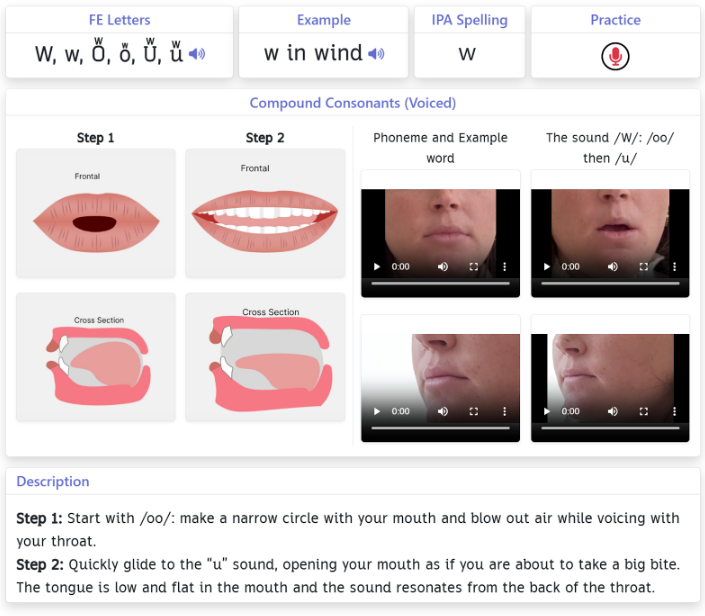
- Cross-language phoneme maps and practice tools –
Fo√ne…tic √Ēng…lish has compared English phonemes to the sounds of other languages. Most languages have a significant number of sounds or phonemes that are in English, and students can already discriminate and pronounce these sounds and don’t need to learn them. Sometimes the common sounds have the same spelling, and there is a teaching tool for students to learn and practice the English spelling of these common words if the spelling is different. This focuses students to learn the sounds that are not in their native language. - Auditory-discrimination trainer –
Fo√ne…tic √Ēng…lish shows the sounds in a word, so learners know what to listen for, which makes auditory discrimination much easier. Have you heard a foreign language speaker say their name, and you couldn’t discriminate the sounds, but when they gave you a card with their name on it, you could discriminate the sound. Interactive exercises help learners hear the difference between similar sounds, improving listening skills and pronunciation. - Record-and-compare pronunciation tools – Learners can record their own speech, compare it to model pronunciations, and track improvement over time.
The
6.2. How does the dictionary help learners?
The Fo√ne…tic √Ēng…lish dictionary clearly shows the sound of every letter in a word is clearly shown, even when a letter does not make its usual sound, plus syllable breaks, stress marks, and silent. It includes clear pronunciation of each word, syllable, and phoneme, plus clear definitions and examples so learners connect spelling, sound, and meaning together.
The
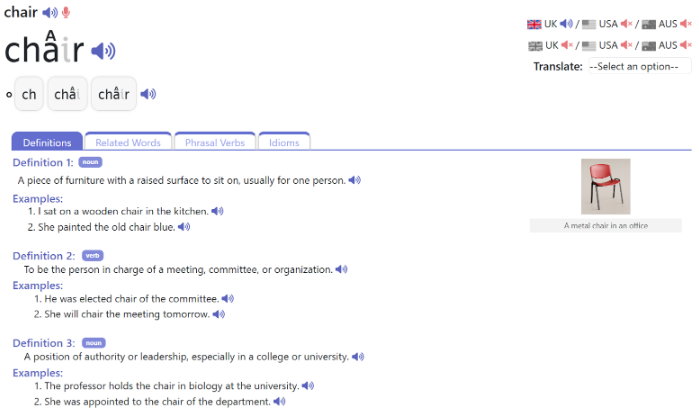
Each entry includes:
- Full
Fo√ne…tic √Ēng…lish markup — The sound of every letter in a word is clearly shown, even when a letter does not make its usual sound, and syllable breaks, stress marks, and silent letters are explicitly shown. This makes the sound of the word completely clear, even when ordinary spelling is irregular. - Audio support — Learners can hear each word pronounced slowly and clearly. They can also listen syllable by syllable, and even phoneme by phoneme. This reinforces how the word is built from sounds and helps improve both listening and pronunciation.
- Definitions and examples — Each word has simple definitions and at least two example sentences. This makes the meaning clear and shows how the word is used in context.
- Cross-language support — For learners who are not native English speakers, the dictionary can also provide a precise translation into their first language. This confirms the meaning when context is not enough.
- Pronunciation Practice – learners can practice right in the dictionary by recording their pronunciation of the word and comparing their pronunciation to the reference pronunciation on the website. The comparison tool will quickly alternate play their recording and the reference recording as many times as the learner needs to clearly hear the differences, and can self correct.
- Related words- English vocabulary is organised into
- families of related words that share a common root, such as act, action, active, react, actor, and activate. Recognising these relationships allows learners to infer meaning, reduce memorisation load, and understand how prefixes and suffixes modify words.
- In addition to root-based families, many English words form compound words, where two or more words combine to create a new meaning, such as sunlight, notebook, classroom, or supermarket. Compound words are especially useful for learners, because the meaning is often transparent once the parts are recognised.
Fo√ne…tic √Ēng…lish supports both word families and compound words by clearly marking pronunciation, stress, and syllable structure, making it easier for learners to decode each component accurately. By presenting these related forms in a structured way,Fo√ne…tic √Ēng…lish helps students store vocabulary as meaningful patterns rather than isolated items, greatly accelerating vocabulary growth and reading fluency.
- Phrasal verbs are combinations of a verb and a particle (e.g., turn off, look up, get over, break down) whose meanings are often not predictable from the individual words. They are one of the most challenging aspects of English because they behave like idioms: their meanings shift depending on context, tense, and even stress.
Fo√ne…tic √Ēng…lish assists learners by marking the pronunciation and stress of each phrasal verb clearly, helping students distinguish similar forms (e.g., take off, take up, take over).Fo√ne…tic √Ēng…lish also allows students to learn phrasal verbs as structured items rather than as random expressions, reducing the memory burden and helping learners master these essential but difficult forms of English.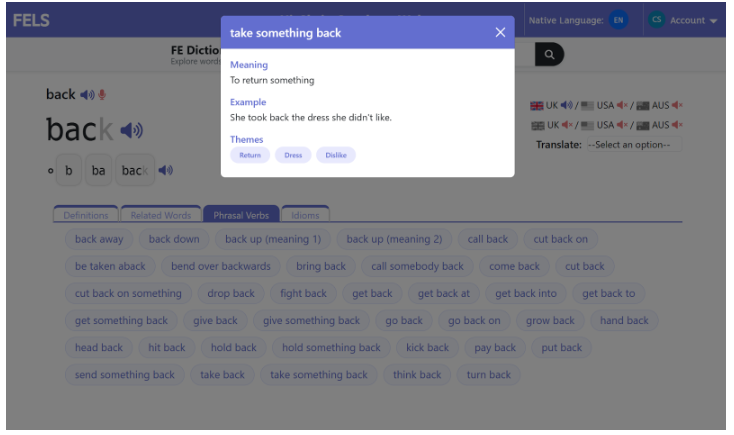
- Idioms are fixed expressions whose meanings cannot be deduced from the individual words, such as “spill the beans,” “hit the nail on the head,” or “once in a blue moon.” Because the meaning is figurative rather than literal, idioms can be confusing for learners, and pronunciation often carries important cues to tone, emphasis, and intent.
Fo√ne…tic √Ēng…lish helps by ensuring that learners can pronounce idioms clearly and naturally, with accurate stress and rhythm, so the expressions sound authentic and are easier to remember. By removing the difficulty of decoding irregular spellings,Fo√ne…tic √Ēng…lish allows learners to focus on understanding and using idioms correctly in real communication.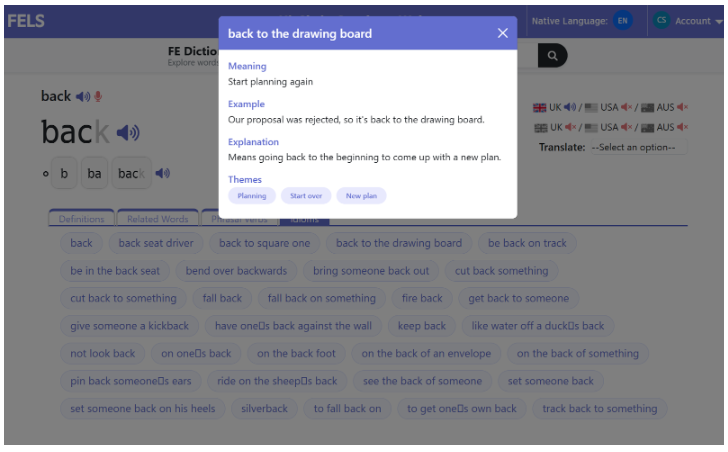
The result is a faster and easier path to fluency: vocabulary grows faster, comprehension improves, and learners build the confidence to read and speak in English.
6.3. How does the app help with pronunciation and listening?
The Fo√ne…tic √Ēng…lish app helps learners practise the 42 English sounds, hear words syllable by syllable and phoneme by phoneme, and record and compare their own pronunciation. This strengthens sound discrimination, listening, and speaking skills.
The
1. Complete sound coverage — The app includes all 42 English phonemes. Each sound is taught with clear audio, mouth-movement instructions, and videos showing how to form the sound.
2. Progressive sounding out — Words can be heard as whole words, syllable by syllable, and phoneme by phoneme. For example the single syllable word “strengths” can be progressively sounded out as
Progressive sounding-out: there are just two pieces in working memory so even long syllables can be sounded out:
1. the blended sound so far, and
2. the next sound to add.
Worked example — the syllable “strengths”:
1. s + t → st
2. st + r → str
3. str + e → stre
4. stre + ng → streng
5. streng + th → strength
6. strength + s → strengths
This shows that even the hardest-looking words can be decoded in small, manageable steps.
3. Syllable-based practice — Because most long words can be broken into 2–4 syllables, sounding them out syllable by syllable makes even complex words manageable. Learners quickly see that long words are not overwhelming.
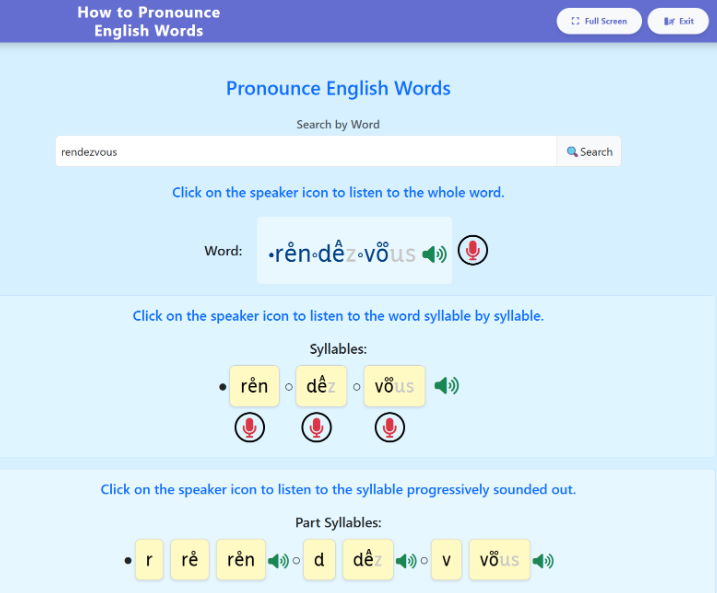
4. Record–compare–repeat — Learners can record their pronunciation of phonemes, syllables, or words and then compare it with the reference sound on the website. Playback alternates between the reference and the learner’s recording, sharpening auditory discrimination and improving accuracy.
5. Listening and comprehension gains — By repeatedly distinguishing similar sounds (like ship vs. sheep or thin vs. then), learners strengthen their listening skills. This helps them understand spoken English more easily in everyday situations.
Together, these tools allow learners not just to practise saying words, but to hear, discriminate, and remember sounds more effectively. Over time, pronunciation becomes clearer, listening comprehension improves, and learners gain confidence in both reading aloud and everyday speech.
6.4. How does Fo√ne…tic √Ēng…lish improve auditory discrimination?
Many people have had the experience of hearing a non-native speaker say their name and not being able to discriminate it clearly. But as soon as you see the name written down, you can suddenly 'hear' it accurately — because now you know what to listen for.
This linking of print and sound trains the ear to tell similar sounds apart more reliably. For learners, this strengthens listening comprehension, pronunciation accuracy, and overall confidence in both reading and speaking.
6.5. What are “mouth movement instructions” and why do they matter?
They are step-by-step guides (with front and side videos) showing lips, tongue, and jaw positions. Seeing and feeling correct placement builds accurate, confident pronunciation. Recording and comparing your sounds against Fo√ne…tic √Ēng…lish references improves both pronunciation and listening.
Mouth movement instructions are guides that show learners exactly how to shape sounds with the lips, tongue, and jaw.
For many learners, seeing what to do physically makes a big difference. Instead of trying alternatives blindly, you know precisely how to position your mouth to create the correct sound.
This also creates a positive feedback loop: if you struggle to discriminate a sound — for example, the English “th” — the mouth movement is simple. When you place your tongue correctly between your teeth and blow air, you hear yourself make the correct sound. Hearing your own accurate sound immediately strengthens your ability to discriminate it in others’ speech. The better you discriminate, the easier it becomes to self-correct and refine your pronunciation.
Learners can also record themselves and compare their pronunciation to the reference sounds provided in the
6.6. How do “record and compare” tools work?
“Learners record themselves saying a sound, syllable, or word, then play it back so they can compare to the Fo√ne…tic √Ēng…lish reference sound on the website. Alternating playback between your recording and the Fo√ne…tic √Ēng…lish reference sound trains your ear to hear even subtle differences, so learners self-correct and improve both speaking and listening.”
The “record and compare” tools give learners direct feedback on their pronunciation by comparing their recording to the reference recording on the website. The process is simple but powerful:
- Record — Learners speak a sound, syllable, or full word into the app.
- Compare — The app plays back the learner’s voice alternated with the
Fo√ne…tic √Ēng…lish reference, repeating until the learner stops it. - Hear the difference — Because the two recordings rapidly alternate, even small differences become clear to the ear. Learners quickly notice if their sound is too short, too long, or formed in the wrong place.
- Self-correct — Hearing the contrast guides learners to adjust their lips, tongue, or jaw until their sound matches the reference.
This cycle builds a positive feedback loop: improved discrimination makes self-correction easier, strengthens pronunciation, and in turn makes auditory discrimination even stronger.
For example, with the English th sound, many learners struggle to hear and produce it correctly. By recording themselves, placing their tongue between their teeth, and then comparing with the reference, they can both hear and feel when they get it right. This accelerates learning far more quickly than practice without feedback.
Over time, repeated use of record-and-compare tools helps learners speak more clearly, listen more accurately, and gain confidence in real conversations.
6.7. How does Fo√ne…tic √Ēng…lish teach English sounds that are not in your native language?
Every language has its own set of sounds, called phonemes. English has 42 phonemes, but many are not found in other languages. For example:
- Spanish does not have the English sh sound.
- Japanese does not distinguish between r and l.
- Many languages lack the English th sounds (as in thin and then).
When a sound is missing from a learner’s first language, it is much harder to hear and pronounce correctly.
- Identify the gap —
Fo√ne…tic √Ēng…lish cross-language phoneme maps show which English phonemes are present in your first language and which are missing. This helps learners and teachers target their practice. - Show common English starting with or containing the missing sound. English is used so widely that many people know borrowed English words, place names, brands etc that contain the missing English sounds. These are displayed to see if learners recognize any of the missing sounds.
- Practice recognizing missing sounds. A sound is played and learners must click on the
Fo√ne…tic √Ēng…lish letters that spell out the sound they just heard. The sounds that are played are syllables that have one missing sound and 2 or more sounds that are in both the foreign language and in English, so the learner will be able to recognize the syllable sound as it contains sounds they know and so can practice effectively. The next step is to hear syllables played with just one common sound and the missing sound, and then hearing the missing sounds by themselves. - Tongue twisters. Learners can practice with similar words that are hard to discriminate, such as “then” and “thin”, which will further improve their auditory discrimination skills.
- Show how to make the sound — Mouth-movement videos demonstrate exactly how to place the lips, tongue, and jaw. Seeing the movement makes it clear how the new sound is formed. When you can make the new sound, you will also be able to hear it, which creates a positive feedback loop.
- Practise with feedback — Learners record themselves producing the sound and compare it to the
Fo√ne…tic √Ēng…lish reference. The alternating playback makes even small differences obvious, so learners can adjust and improve quickly.
These tools — knowing what sounds are missing, recognizing missing sounds already knows, practicing recognizing the missing sounds using syllable containing common sounds, practicing with tongue twisters, seeing how to make the sound, and practicing pronunciation — ensures that learners will be able to both hear and produce new sounds accurately.
Over time, these once unfamiliar phonemes become part of the learner’s working sound system. That leads to clearer speech, sharper listening, and greater confidence in real communication.
6.8. Why does traditional sounding-out overload working memory?
Deliberate practice means focused, structured work on weak areas with clear feedback. Fo√ne…tic √Ēng…lish supports this by showing exactly which sounds, syllables, or stress patterns need work, and providing tools like record‑and‑compare and discrimination games to give immediate, targeted feedback.
Deliberate practice is not just repetition. It is targeted, structured practice on specific skills that need improvement, with clear goals and feedback. This is the most effective way to build expertise in language learning, as in music or sport.
Immediate feedback — alternating playback, instant discrimination results, and clear visual information showing word sound — makes progress obvious. Setting goals for accuracy and speed helps learners stay motivated. Practice is not random or unfocused but deliberate and efficient.
This turns weaknesses into strengths, builds accurate pronunciation, speeds recognition of sightwords, and improves fluency and comprehension.
6.9. What does fossilization mean in language learning?
Fossilization happens when errors in speech or reading become permanent habits, even after years of practice. Fo√ne…tic √Ēng…lish helps prevent fossilization by making every sound, syllable, and stress clear from the start, so learners practise the right patterns instead of repeating mistakes.
Fossilization means that mistakes become “frozen” into long‑term habits — for example, mispronouncing a sound, stressing the wrong syllable, or using an incorrect spelling‑to‑sound mapping. Once fossilized, these habits are hard to change, even with years of practice.
Tools such as record‑and‑compare, discrimination games, and slow, clear audio provide reliable feedback so small errors are noticed and corrected. As a result, the correct patterns of sound, stress, and syllables become the habits that stick, making improvement easier over time.
Pillar 7 – Fluent Reading
7.1. What is fluency in reading and why does it matter?
Fluency means reading at the speed we speak. Fluent readers recognise sightwords instantly, making reading faster and easier. This keeps meaning in working memory and improves comprehension.
Fluency in reading means being able to read at about the same speed we speak. Fluency matters because it directly supports comprehension. When we read fluently, we repurpose the same parts of the brain that process speech, allowing us to hear and understand the words silently in our minds. We naturally understand more when we read at the speed we speak and listen. If reading is fluent, comprehension improves because the reader can focus on meaning rather than effort.
A fluent reader does not need to stop and puzzle over each word — they recognise most words instantly as sightwords – they see the word and instantly know its sound and meaning. When words are recognised automatically, reading becomes both faster and easier. This allows the brain to hold onto the flow of meaning across phrases, sentences, and paragraphs.
When you have to stop and decode, reading slows down and the meaning of the sentence can fade from working memory. If reading is slow and broken, comprehension suffers.
Sightwords are the foundation of fluency. The more sightwords a learner has, the less they need to decode, and the more they can focus on understanding. This is why fluency is such an important goal in learning to read: it bridges the step between word recognition and real comprehension.
7.2. How does Fo√ne…tic √Ēng…lish help build fluency?
Sightwords are words you can recognize instantly. Fo√ne…tic √Ēng…lish speeds up sightword growth. Learners decode sounds quickly and tie them to word shapes, so words become sightwords faster. With more sightwords, reading becomes fluent sooner, and comprehension improves.
Fluency depends on sightwords — words you recognise instantly, without stopping to decode. The more sightwords you know, the faster and easier you read, and the better you understand.
In English, learning sightwords is slow because the spelling often doesn’t match the sound. There are 26 letters but 42 sounds, so many letters make more than one sound. The information needed to accurately decode the sound of many words is not provided by English spelling. Many English words are not pronounced as spelled, and the sound, shape and spelling of the word must be memorised by rote.
- when a letter makes a different sound from its usual one,
- which letters are silent,
- where the syllables break, and
- which syllable is stressed.
This means you can always decode the sound of a new word. For example, the word present can be pronounced in two different ways, depending on which syllable is stressed — PREsent (a gift) or preSENT (to give). Standard spelling doesn’t tell you which is right, but
When you decode a word in
As sightwords grow quickly, reading becomes fluent sooner. And once reading is fluent — at the speed we speak — comprehension improves, because the reader can focus on meaning instead of effort.
7.3. Why is comprehension linked to fluency?
“We understand better when we read fluently because reading at the speed of speech lets us use the same parts of the brain that understand spoken language. More sightwords mean faster reading, which leads to better comprehension.”
Comprehension and fluency are tightly linked. Fluency means reading at about the speed we speak. When we read fluently, we repurpose the same parts of the brain that understand spoken language. This lets us hear the words silently in our minds and process them in the same way we process speech.
If reading is slow and broken, the information in working memory is lost before we can understand all the words in a sentence, reducing or even stopping comprehension. But when reading is fluent, you have access to more information in working memory which makes it easier to understand.
Fluency depends on having a large store of sightwords — words you recognise instantly and know the sound and meaning without decoding. The more sightwords you know, the faster you read. And the faster you read, the easier it is to understand.
In short, comprehension improves with fluency because fluent reading allows the brain to process text like speech: quickly, automatically, and with meaning intact.
7.4. How does Fo√ne…tic √Ēng…lish improve comprehension?
With Fo√ne…tic √Ēng…lish , learners can decode sounds easily and this allows more focus on meaning. The eReader shows translations where needed, so meaning is never lost. Accurate sound plus clear meaning helps new words become sightwords, making reading more fluent and comprehension stronger.
Comprehension improves when learners can focus on meaning instead of struggling with sound. Standard English spelling often lack the information to decode the correct sound, which forces readers to look up the information elsewhere, interrupting the flow of reading. When that happens, comprehension suffers.
- the sound a letter makes a when it does not make its usual sound,
- which letters are silent,
- where the syllables break, and
- which syllable is stressed.
With this information, learners can always decode the sound of the word quickly and accurately. Once the sound is clear, the meaning is often obvious from the sentence or paragraph. If it isn’t, the
Accurate sounding out and meaning turns new words into sightwords faster. With more sightwords, reading becomes fluent. And once reading is fluent — at the speed we speak — comprehension naturally becomes stronger and requires less effort.
7.5. Why is building a large vocabulary important for comprehension?
Comprehension depends on knowing the meaning of enough words. The larger your vocabulary, the more sentences you understand. With Fo√ne…tic √Ēng…lish , you can decode new words, remember them more easily, and grow your vocabulary faster, which makes comprehension stronger.
Comprehension depends on vocabulary. If you don’t know the meaning of enough words, whole sentences or passages may be unclear, even if you can read them fluently. The larger your vocabulary, the more meaning you can extract from what you read.
In English, building vocabulary is often slow because the spelling does not consistently show the sounds. With 26 letters but 42 sounds, letters can make more than one sound. This makes the sound of new words hard to decode and remember, so it can take many exposures before a word becomes familiar.
- the sound a letter makes when it does not make its usual sound,
- which letters are silent,
- where the syllables break, and
- which syllable is stressed.
With this information, learners can always decode the sound of a new word correctly. When the spelling, sound, and word shape all make sense together, the word is easier to remember and becomes a sightword more quickly.
If the meaning is not clear from context, the
The word “information” in an eReader document has been clicked on, showing a speaker to hear “information” pronounced, the word “pronunciation” translated into Japanese, and the Part of Speech, a noun.
As vocabulary grows, comprehension strengthens. With more words available in memory, readers can follow arguments, stories, and explanations without interruption.
7.6. How does a limited vocabulary affect reading?
With a small vocabulary, readers struggle to understand sentences and lose the flow of meaning. Fo√ne…tic √Ēng…lish helps by making new words easier to decode, remember, and turn into sightwords and clicking on the word shows its precise translation into the reader’s native language. This grows vocabulary faster, supporting comprehension.
A limited vocabulary makes reading difficult. If you don’t know many words, even simple sentences can feel confusing. You may understand part of the sentence but miss the full meaning, or lose the thread of a paragraph because too many words are unfamiliar. This slows reading and interrupts comprehension.
Building vocabulary in English is often slow because spelling does not provide enough information to accurately and easily decode the sounds of written words. Learners may need to encounter a new word many times before it becomes familiar. With a small vocabulary, reading can be frustrating because you don’t understand much.
If the meaning is not clear from context, the
As vocabulary grows, comprehension strengthens. With
7.7. How does comprehension grow over time with Fo√ne…tic √Ēng…lish ?
Comprehension grows as vocabulary and fluency build together. Fo√ne…tic √Ēng…lish speeds both processes by making words easier to decode, remember, and turn into sightwords. With more sightwords and faster reading, comprehension becomes deeper and more reliable.
Comprehension doesn’t appear all at once — it grows step by step. As learners gain more sightwords, they read faster and with less effort. As their vocabulary expands, they understand more sentences and ideas. Together, fluency and vocabulary steadily build comprehension.
Learners can work out the sound of new words reliably, remember them more easily, and turn them into sightwords sooner.
With more sightwords, reading speed increases. With more vocabulary, meaning is clearer. The two reinforce each other: faster reading strengthens comprehension, and stronger comprehension makes it easier to learn new words from context.
If the meaning is not clear from context, the
The word “information” in an eReader document has been clicked on, showing a speaker to hear “information” pronounced, the word “pronunciation” translated into Japanese, and the Part of Speech, a noun.
Over time, this cycle produces confident readers. With
7.8. How does comprehension help with learning other subjects?
Reading is the gateway to all learning. With stronger comprehension, students can follow lessons, textbooks, and instructions more easily. Fo√ne…tic √Ēng…lish helps build fluency and vocabulary faster, so comprehension grows and learning in every subject improves.
Reading comprehension is the foundation of learning across all subjects. Whether a student is studying science, history, or mathematics, they need to understand what they read in textbooks, instructions, and questions. If comprehension is weak, every subject becomes harder.
If the meaning is not clear from context, the
With stronger comprehension, students can follow explanations, understand instructions, and learn new concepts in every subject. Reading is the gateway to learning, and
7.9. How does better comprehension help with exams and assessments?
Exams test understanding through reading. Students with stronger comprehension can read questions faster, understand them clearly, and give better answers. Fo√ne…tic √Ēng…lish speeds fluency and vocabulary growth, making comprehension stronger and exam performance better.
Exams and assessments rely heavily on reading. To succeed, students must be able to read the questions quickly, understand exactly what is being asked, and respond within the time allowed. If comprehension is weak, students may misread a question, misunderstand it, or spend too long working out what it means — leaving less time to write the answer. Having strong comprehension will also allow students to write better answers.
If the meaning is not clear from context, the
The word “information” in an eReader document has been clicked on, showing a speaker to hear “information” pronounced, the word “pronunciation” translated into Japanese, and the Part of Speech, a noun.
As sightwords grow, reading becomes fluent — at the speed we speak — and comprehension improves.
Stronger comprehension means students can:
- read questions quickly without getting stuck,
- understand the meaning accurately, and
- focus their effort on giving the best possible answer.
By making comprehension stronger,
7.10. How does stronger comprehension help lifelong learning?
Reading is not just for school. Strong comprehension helps with work, further study, and everyday life. Fo√ne…tic √Ēng…lish builds fluency and vocabulary quickly, so comprehension grows and learners are equipped for a lifetime of learning.
Reading comprehension is a skill that extends far beyond school. In work, further study, and daily life, we are constantly required to read — instructions, reports, articles, forms, and even digital content. Strong comprehension makes these tasks easier and faster, and it enables people to keep learning throughout their lives.
If the meaning is not clear from context, the
The word “information” in an eReader document has been clicked on, showing a speaker to hear “information” pronounced, the word “pronunciation” translated into Japanese, and the Part of Speech, a noun.
With this information, learners can decode any new word reliably, know its meaning, remember it more easily, and turn it into a sightword.
As vocabulary grows and reading becomes fluent, comprehension deepens. Stronger comprehension equips learners not only to succeed in school, but also to keep learning in their jobs, pursue further education, and manage the demands of everyday life with confidence.
With
Pillar 8 – The Scientific Principles applied by Fo√ne…tic √Ēng…lish
8.1. What scientific principles does Fo√ne…tic √Ēng…lish use?
The fundamental scientific principle behind
Humans have evolved two different learning systems:
1. Biologically primary learning
- Speech and listening
- Facial recognition
- Social understanding
- Basic motor skills
- Ability to learn information and skills that are explicitly taught
These skills are learned effortlessly, without instruction. They develop naturally because humans have evolved neural mechanisms for them. Biologically primary learning does not rely on repetition — humans learn these abilities simply because we have evolved to learn them.
2. Biologically secondary learning
Anything humans learn that is not something we have evolved to learn is called biologically secondary knowledge.
These biologically secondary skills include:
- Reading
- Writing
- Spelling
- Academic vocabulary
Biologically secondary skills:
- Are not natural to the human brain
- Must be explicitly taught
- Rely on memory systems
- Compete with working-memory limits
- Do require repetition to consolidate
Why repetition matters for written words When learning written words:
- If the spelling system is phonetic and consistent, the sound, spelling, and shape of the word all make sense, so the word can often be learned in as
Fo√ne…tic √Ēng…lish Fo√ne…tic √Ēng…lish Fo√ne…tic √Ēng…lish w as 2–5 repetitions. - Because the brain’s evolutionary filters are designed to ignore random patterns, if spelling is irregular, inconsistent, or unpredictable, the brain treats it as random information, and may require 20–50 repetitions to overcome those filters.
The problem with English
English spelling is:
- Deep, irregular, unpredictable
- Filled with exceptions
- Poorly aligned with pronunciation
Therefore:
- Memory retention is low
- High repetition is required
- Students forget words easily
- Vocabulary development is slow
- Pronunciations fossilise incorrectly
What
- Making vowel sounds explicit
- Marking stress and syllables
- Identifying silent letters
- Revealing consistent patterns
Meaningful, structured words can be stored with as few as 2–5 repetitions, rather than the 20–50 repetitions often needed for irregular spelling.
This is the scientific reason
Supporting Scientific Principles Behind
The core evolutionary insight above is supported by several well-established research domains.
3. Cognitive Load Theory (John Sweller)
Irregular spelling creates unnecessary cognitive load because learners must:
- Guess pronunciation
- Memorise exceptions
- Manage unpredictable vowels
- Handle silent letters
- Cope with inconsistent stress
This allows working memory to focus on comprehension rather than guessing.
4. Explicit Instruction + Retrieval Practice (Roediger, Bjork)
Research shows that learning is strongest when the cycle is:
Explicitly teach → Test (Recall) → Correct → Spaced Practice
- Decode a word
- Recall syllables
- Recall stress
- Re-encounter words in later texts
- Cope with inconsistent stress
Because
5. Deliberate Practice (Anders Ericsson)
Deliberate practice is characterised by:
- Clear, specific goals
- Immediate feedback
- Repetition with refinement
- Gradually increasing challenge
- Model pronunciations
- Record-and-compare correction
- Step-by-step decoding
- Progressive exposure to more complex words
6. Neural Plasticity and Auditory Discrimination (Hebb, Merzenich, Kuhl)
Key scientific principles:
- “Neurons that fire together wire together” (Hebb)
- Adult auditory systems remain plastic and can reorganise (Merzenich)
- Learners reshape phoneme categories through structured exposure (Kuhl)
- /b/ vs /p/ (Arabic)
- /l/ vs /r/ (Japanese)
- /v/ vs /w/ (Hindi/Urdu)
- /ɪ/ vs /iː/ (Vietnamese)
7. Pronunciation as Motor Learning (Guenther, Flege)
Pronunciation is a motor skill involving:
- Lips
- Tongue
- Jaw
- Breath control
- Timing
- Providing model audio
- Allowing record-and-compare refinement
- Teaching prosody (intonation, rhythm, cadence, stress)
- Preventing incorrect motor patterns from becoming automatic
8. Fossilisation and the Importance of Early Feedback
Incorrect pronunciation becomes “locked in” if reinforced repeatedly.
- Giving the correct pronunciation at the first encounter
- Reinforcing correct syllable and stress patterns
- Allowing learners to compare their speech to a reference model
9. Fossilisation and the Importance of Early Feedback
In Italy, dyslexia is rarely diagnosed. In a research study published in 2001, researchers searching for an Anglo-Saxon dyslexia gene administered literacy tests to 1,200 Italian university students. The 18 students with the lowest scores were given PET scans, which showed that all 18 were dyslexic. What surprised the researchers was that these students had learned to read Italian well enough to reach university without any specific reading interventions.
This study demonstrates how a phonetic language like Italian can greatly assist dyslexic students to learn to read. Italian’s consistent spelling–sound system effectively compensated for dyslexic decoding weaknesses.
10. Sightword Formation (Linnea Ehri)
Sightwords form when spelling, sound, and meaning fuse into a single memory.
11. Morphology (Prefixes, Suffixes, Roots)
- Highlighting root families
- Making meaning connections visible
- Reducing the number of separate items students must memorise
Learners only need to learn the meaning of root words, as they have learned learned the meanings of prefixes and suffixes, and so can infer meaning of a root word with prefixes and suffixes, and remember these words quickly and easily. There are about 6,700 words to be learned for IELTS level 5, but there are only around 4000 root words that need to be learned, which can save the student a lot of time and effort.
Summary
The scientific foundation of
The brain stores structured, meaningful information easily — and filters out random information.
Meaningful structure requires as few as 2–5 repetitions; irregular spelling may require 20–50.
All supporting scientific principles — Cognitive Load Theory, retrieval practice, deliberate practice, neural plasticity, motor learning, dyslexia research, sightword formation, and morphology — reinforce this core evolutionary insight.
8.2. What is Human Cognitive Architecture and how does it relate to learning English?
Human Cognitive Architecture (David Geary) separates learning into two categories:
1. Biologically primary learning (natural learning)
Skills humans evolved to learn without instruction, such as:
- Speech and listening
- Facial recognition
- Social understanding
- Basic motor skills
- Learning through imitation and observation
These skills develop naturally because humans have evolved specialised neural systems for them2. Biologically secondary learning (explicit learning)
These include:
- Reading
- Writing
- Spelling
- Academic vocabulary
- Grammer
- Mathematics
These skills:
- Are not natural to the human brain
- Must be explicitly taught
- Use working memory
- Require repetition to memorize them
- Are highly sensitive to instructional design
Why this matters for English
When written words “make sense” (i.e., phonetic and consistent):
- They can be learned in as few as 2–5 repetitions
When written words appear random (irregular or inconsistent spelling):
- The brain’s evolutionary filters suppress them
- They may require 20–50 repetitions to learn
8.3. What is Cognitive Load Theory and how does Fo√ne…tic √Ēng…lish apply it?
Cognitive Load Theory (CLT) is how to present information to transfer it from working memory into long term memory, which can be called learning or understanding. Working memory has strict limits.
Irregular English word spelling does not contain enough information to be able to accurately decode the sounds of those words. Students have to find the pronunciation some other way. When students find the correct pronunciation, the sound, spelling and word shape usually does not make sense, so they need multiple repetitions to be able to remember it. elsewhere, or many overloads it because students must:
Irregular English word spelling does not contain enough information to be able to accurately decode the sounds of those words. Students have to find the pronunciation some other way. When students find the correct pronunciation, the sound, spelling and word shape usually does not make sense, so they need multiple repetitions to be able to remember it. elsewhere, or many overloads it because students must:
- Find out what sounds letters make when the letters do not make their usual sounds
- Handle silent letters
- Try to guess syllable breaks and which syllable is stressed
- Sometimes students will just guess the pronunciation because it is to frustrating to try find out the correct pronunciation
How
This transforms decoding from guesswork into structured processing.
Working memory is freed to focus on comprehension, meaning:
- Faster learning
- Higher accuracy
- Reduced frustration
- Greater long-term retention
CLT technique: Worked examples
FE provides a complete analysis of the sounds of any English word. Click on the speaker icon to hear the word pronounced as a word, syllable by syllable, and any syllable can be progressively sounded out. You can also compare your pronunciation to the reference pronunciation on the website.
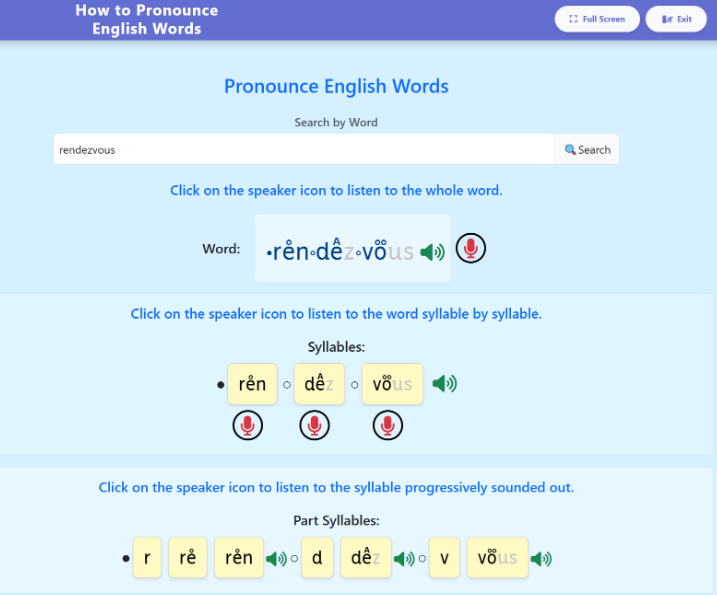
Providing examples is a core CLT method for reducing cognitive load and accelerating schema acquisition.
8.4. What is retrieval practice and why is it central to Fo√ne…tic √Ēng…lish ?
Retrieval practice is one of the strongest findings in memory science. It shows that learners remember far more when they actively recall information rather than rereading it.
Explicitly teach → Test (Recall) → Correct → Spaced Practice
This approach produces:
Explicitly teach → Test (Recall) → Correct → Spaced Practice
This approach produces:
- Stronger, longer-lasting memory
- Faster consolidation
- Better transfer to new contexts
How
Learners repeatedly:
- Recall the correct vowel sound
- Recall the syllable structure
- Recall the stress pattern
- Re-encounter the word in later texts
- Compare their pronunciation to a model
- Retrieve the meaning from morphology (prefixes/suffixes)
Because
8.5. What is deliberate practice and how does Fo√ne…tic √Ēng…lish support it?
Deliberate practice (Anders Ericsson) involves:
It is the engine behind expertise development in all complex skills.
- Specific goals
- Immediate feedback
- Repetition with correction
- Incremental difficulty
It is the engine behind expertise development in all complex skills.
How
- A clear goal: decode and pronounce the word
- Immediate auditory feedback
- Opportunities to record and compare
- Progressive complexity as learners move from simple to multisyllabic words
Every interaction in
8.6. How does Fo√ne…tic √Ēng…lish support neural plasticity and sound discrimination?
Research from Hebb, Merzenich, and Kuhl shows:
It is the engine behind expertise development in all complex skills.
- Neurons strengthen through repeated, meaningful activation (“neurons that fire together wire together”).
- Adults retain the ability to reorganise auditory pathways.
- Learners form “phoneme categories” based on their native language, which can distort new sounds.
It is the engine behind expertise development in all complex skills.
- /b/ vs /p/ (Arabic)
- /l/ vs /r/ (Japanese)
- /v/ vs /w/ (Hindi/Urdu)
- /ɪ/ vs /iː/ (Vietnamese)
How
- Making phoneme differences visible
- Reinforcing correct auditory categories
- Preventing ambiguous or misleading cues
- Providing consistent, precise models for imitation
This helps learners acquire English phonemes even when absent from their native language.
8.7. Why is pronunciation a motor skill, and how does Fo√ne…tic √Ēng…lish help?
Pronunciation involves coordinated movement of:
This makes pronunciation a motor skill, similar to learning a musical instrument.
- Lips
- Tongue
- Jaw
- Breath
- Timing
- Resonance
This makes pronunciation a motor skill, similar to learning a musical instrument.
How
- Providing precise model recordings
- Allowing learners to record themselves and compare
- Showing stress, rhythm, and syllable boundaries clearly
- Helping learners refine their articulatory movements
- Preventing early development of incorrect motor patterns
8.8. What is fossilisation and how does Fo√ne…tic √Ēng…lish prevent it?
Fossilisation occurs when incorrect pronunciation becomes “locked in” because:
Once fossilised, errors are extremely hard to correct.
- The learner practised the wrong sound
- There was no corrective feedback
- The sound was never contrasted properly
- The learner memorised an incorrect sightword
Once fossilised, errors are extremely hard to correct.
How
- The learner sees the correct pronunciation from the first exposure
- Silent letters are clear
- Stress is explicit
- Vowel sounds cannot be guessed incorrectly
- Learners receive immediate auditory comparison
8.9. What does the Italian dyslexia study show, and why is it relevant to FE?
Italian Dyslexia Study (2001): Why Phonetic Systems Help Dyslexic Readers)
In Italy, dyslexia is rarely diagnosed. In a research study published in 2001, researchers searching for an Anglo-Saxon dyslexia gene administered literacy tests to 1,200 Italian university students. The 18 students with the lowest scores were given PET scans, which showed that all 18 were dyslexic. What surprised the researchers was that these students had learned to read Italian well enough to reach university without any specific reading interventions.
This study demonstrates how a phonetic language like Italian can greatly assist dyslexic students to learn to read. Italian’s consistent spelling–sound system effectively compensated for dyslexic decoding weaknesses.
Fo√ne…tic √Ēng…lish makes English phonetic and therefore has the potential to greatly assist dyslexic students to learn to read English.
In Italy, dyslexia is rarely diagnosed. In a research study published in 2001, researchers searching for an Anglo-Saxon dyslexia gene administered literacy tests to 1,200 Italian university students. The 18 students with the lowest scores were given PET scans, which showed that all 18 were dyslexic. What surprised the researchers was that these students had learned to read Italian well enough to reach university without any specific reading interventions.
This study demonstrates how a phonetic language like Italian can greatly assist dyslexic students to learn to read. Italian’s consistent spelling–sound system effectively compensated for dyslexic decoding weaknesses.
How
- The learner sees the correct pronunciation from the first exposure
- Silent letters are clear
- Stress is explicit
- Vowel sounds cannot be guessed incorrectly
- Learners receive immediate auditory comparison
8.10. How does Fo√ne…tic √Ēng…lish improve vocabulary learning through sightwords and morphology?
Sightword formation (Linnea Ehri)
Sightwords form when:
Fo√ne…tic √Ēng…lish accelerates sightword formation by:
Sightwords form when:
- Spelling
- Sound
- Meaning
- Ensuring correct pronunciation on every exposure
- Making spelling–sound connections clear
- Reinforcing consistency through repeated texts
Morphology (prefixes, suffixes, roots)
- Understand root families
- Infer meanings from the root word and the prefixes and suffixes, which reduces the number of root words to memorize
- Learn academic vocabulary faster
Pillar 9 – How does Fo√ne…tic √Ēng…lish support Readers
9.1. How does Fo√ne…tic √Ēng…lish reduce frustration in learning to read?
Ordinary English spelling often causes frustration because it is hard to decode. Fo√ne…tic √Ēng…lish reduces frustration by showing the sound, silent letters, syllables, and stress directly. This makes reading manageable and keeps learners motivated.
Learning to read in English can be frustrating because the spelling system is inconsistent. Learners may spend minutes puzzling over a single word, only to get it wrong. This constant uncertainty slows progress and discourages learners.
- the sound a letter makes when it does not make its usual sound,
- which letters are silent,
- where the syllables break, and
- which syllable is stressed.
This way, learners can always decode the word themselves. They no longer waste energy guessing or memorising irregular words by rote. When the meaning isn’t clear from context, the
9.2. How does Fo√ne…tic √Ēng…lish build learner confidence?
Confidence grows when learners can decode any word and confirm its sound and meaning. Fo√ne…tic √Ēng…lish makes this possible by giving the missing information, so learners feel in control of their reading.
Confidence in reading comes from knowing you can handle any word you meet. With ordinary English spelling, learners often feel uncertain — is this letter silent? does it make its usual sound? which syllable is stressed?
When the meaning is not clear from context, the
The word “information” in an eReader document has been clicked on, showing a speaker to hear “information” pronounced, the word “pronunciation” translated into Japanese, and the Part of Speech, a noun.
This combination — accurate decoding plus immediate access to meaning — gives learners control. Each success builds confidence, and confidence leads to more practice and faster progress.
9.3. How does Fo√ne…tic √Ēng…lish support motivation?
Motivation grows when learners succeed quickly and enjoy what they read. Fo√ne…tic √Ēng…lish makes decoding easier, turns new words into sightwords faster, and supports comprehension. Learners can also read texts that interest them, which increases motivation and pleasure.
Motivation is strongly linked to success and enjoyment. When learners struggle with irregular spelling, progress is slow, mistakes pile up, and motivation often fades.
Fo√ne…tic √Ēng…lish em√beds āll tңê in…for√mâ…ťiòn yoů nêed tȷ √qüick…lý, in√tů…it…ive…lý and √acc…ů…rate…lý sijund ijut √än…ý √Ēng…lish wòrd, which is tңè √rê…ál ob√jec…tive of √Рho…nics 1.0. With Fo√ne…tic √Ēng…lish, thẂre iş next tȷ √nò…thing tȷ learn! √Män…ý √pêo…ဇle can √fig…ure ijut Fo√ne…tic √Ēng…lish just bΥ √sêe…ing text in Fo√ne…tic √Ēng…lish.
This makes remembering the word’s sound much easier. Meaning can usually be worked out from context, but if not, the
The word “information” in an eReader document has been clicked on, showing a speaker to hear “information” pronounced, the word “pronunciation” translated into Japanese, and the Part of Speech, a noun.
Just as importantly, motivation grows when learners enjoy what they are reading. Many people read for pleasure, and
Because words become sightwords more quickly and reading becomes more enjoyable, learners are motivated to keep practising. This steady cycle — success, pleasure, and progress — builds lasting motivation.
9.4. How does Fo√ne…tic √Ēng…lish support independent learning?
A common barrier to learning English is over-reliance on a teacher or textbook. Learners often feel stuck when they meet unfamiliar words and cannot decode or understand them.
Fo√ne…tic √Ēng…lish em√beds āll tңê in…for√mâ…ťiòn yoů nêed tȷ √qüick…lý, in√tů…it…ive…lý and √acc…ů…rate…lý sijund ijut √än…ý √Ēng…lish wòrd, which is tңè √rê…ál ob√jec…tive of √Рho…nics 1.0. With Fo√ne…tic √Ēng…lish, thẂre iş next tȷ √nò…thing tȷ learn! √Män…ý √pêo…ဇle can √fig…ure ijut Fo√ne…tic √Ēng…lish just bΥ √sêe…ing text in Fo√ne…tic √Ēng…lish.
This removes the need to constantly ask for help.
If the meaning isn’t obvious from context, the
The word “information” in an eReader document has been clicked on, showing a speaker to hear “information” pronounced, the word “pronunciation” translated into Japanese, and the Part of Speech, a noun.
The dictionary adds full definitions and slow audio for practice.
Beyond decoding,
By giving learners tools to decode, understand, and practise without constant help,
Pillar 10 – Fo√ne…tic √Ēng…lish provides Positive Feedback
10.1. How does Fo√ne…tic √Ēng…lish show progress in reading?
Progress in reading with
Teachers and parents can track progress by looking at reading speed, accuracy, and comprehension. For learners, the most motivating sign of progress is when reading becomes easier and more enjoyable — they can read longer texts with less effort, and understand more.
The
10.2. How are learners assessed with Fo√ne…tic √Ēng…lish ?
Learners are assessed through their ability to decode, grow sightwords, and comprehend text. Fo√ne…tic √Ēng…lish tools track progress automatically, giving clear feedback to teachers and learners.
Assessment in
- **Decoding:** Learners hear a sound and click on the letter, part-syllable, syllable, or word that spells that sound. They can also listen to syllables being progressively sounded out. This tests auditory discrimination and the ability to match sounds to spellings.
- **Sightword growth:** The system tracks how quickly new words are recognised without effort.
- **Comprehension:** Practice texts include comprehension questions. If an answer is wrong, gentle hints guide the learner toward the right choice, helping them understand why.
The
10.3. How do teachers and parents see learner progress?
One of the strengths of
- how many words a learner can now read as sightwords,
- how fluency (reading at the speed of speech) is improving,
- how comprehension is growing through practice questions and translations.
Reports go deeper than overall speed and comprehension: they also show how learners practise sound-to-spelling recognition — hearing a sound and selecting the correct spelling — how many new words have been decoded, and how often words are recognised without help. Because the
10.4. How does Fo√ne…tic √Ēng…lish encourage learners with feedback?
Learners stay motivated when they can see and feel progress. Encouragement begins with practice. Learners see their progress logged in real time — from practising sound-to-spelling recognition, to decoding words, to answering comprehension questions.
- Every time a learner hears a sound and correctly selects the matching spelling, they succeed on their own.
- The system tracks improvements in speed, fluency, and comprehension, showing learners how far they’ve come.
- When learners answer comprehension questions, mistakes are handled gently: hints guide them toward the right answer and explain why. This makes mistakes part of learning, not something to fear.
This steady cycle of success and constructive feedback builds confidence, reduces anxiety, and keeps learners motivated to continue.
Pillar 11 – The Fonetic eReader
11.1. What does “reading in phrases” mean, and why is it easier?
Reading in phrases means breaking sentences into meaningful conceptual units. Each conceptual unit is a small group of words that carries part of the information in the sentence. Seeing sentences divided into phrases helps students understand how each phrase conveys a distinct part of the sentence’s meaning and makes long sentences easier to understand and remember. Displaying phrases also helps students recognise phrase patterns when reading ordinary text.
When we read normally, we don’t process every word separately — our eyes and brain group words into meaningful “chunks” called phrases. A phrase often carries one idea, such as in the morning, a beautiful garden, or went to school.
In standard text, phrases are not marked, so learners must work out where one phrase ends and another begins. Readers may need to scan a long, complex sentence to work out where the phrase breaks are, before reading it. This uses working memory and adds cognitive load, especially for long sentences.

Displaying text in phrases also trains learners to see how English ideas are grouped — a skill that carries over to normal reading. With practice, they start recognising phrase boundaries automatically, which improves both reading speed and comprehension.
11.2. How does Fo√ne…tic √Ēng…lish use phrases to help understanding?
A long sentence that might seem difficult at first can be divided into just a few short phrases, each carrying one clear idea.
This makes a large amount of information easier to process — our brains handle four or five short phrases far more efficiently than twenty separate words.
Each phrase in FE is both a meaning unit and a speaking unit. The phrase layout shows natural pauses, stress, and rhythm, so learners can read with the flow of spoken English.
For example:
In the middle of the night / the lights suddenly went out / and everyone ran outside.
When text is presented this way, learners don’t need to guess how the ideas fit together — the structure itself shows how thoughts are grouped.
By seeing and hearing phrases as clear meaning units, readers can hold the sentence in working memory, understand more quickly, and remember longer.
If a phrase’s meaning isn’t clear, the FE eReader lets the learner click on it to hear it spoken naturally and see a precise translation into their own language.
This combination of phrasing, sound, and meaning makes even long sentences easy to follow and understand.
11.3. Why are phrasal verbs and idioms kept together in phrase formatting?
Phrasal verbs are especially difficult for non-native speakers because their meanings are not obvious. For example, to come up with does not mean to rise but to think of. Fo√ne…tic √Ēng…lish keeps such phrases together on one line and links each to a clear explanation and translation, so learners can understand and remember them.
Many common English expressions are phrasal verbs—combinations of a verb and a small word such as up, out, on, off, or over. Their meaning often changes completely from the literal sense of the words. For example, look up to someone means to admire, not to raise your eyes.
Idioms behave the same way: spill the beans means reveal a secret, not drop food on the table.
These expressions are difficult for learners because the individual words do not help you predict the overall meaning.
By keeping the whole phrase together in one visual unit,
Each phrasal verb or idiom can be clicked to reveal a short definition, translation, and audio example. This turns confusing multi-word expressions into clear, memorable units that can be practised and reused in conversation.
11.4. How does Fo√ne…tic √Ēng…lish teach the meanings of phrasal verbs and idioms?
Each phrasal verb or idiom can be clicked to show a short definition, an example sentence, and a translation in the learner’s language. Seeing and hearing the phrase as a whole helps learners understand both literal and idiomatic meanings and use them naturally.
When a learner clicks on a phrase, the eReader displays:
- A short, simple definition in English,
- An example sentence showing how it is used, and
- A precise translation in the learner’s native language.
This combination helps learners understand that idioms and phrasal verbs are fixed expressions whose meaning often cannot be guessed.
For example:
She came up with a great idea → She thought of a great idea.
By hearing and reading both versions together, students connect the literal words with the true meaning and usage. Over time, they begin to recognise and use these expressions automatically, turning them into sight-phrases that improve fluency and comprehension.
11.5. Can I see both literal and figurative meanings of idioms?
Yes. The Fo√ne…tic √Ēng…lish eReader can show two meanings side by side — a word-for-word translation and the real figurative meaning. This helps learners see the large gap between what the words literally say and what the phrasal verb or idiom actually means.
Idioms and phrasal verbs are challenging because their literal words often don’t explain their real meaning. For example, in the idiom break the ice, nothing is actually broken or frozen — the phrase means to make people feel more comfortable in a social situation.
The
This approach reduces confusion and helps students remember idioms as complete units rather than as separate words. Over time, they recognise these phrases instantly and use them naturally when speaking or writing.
11.6. How does the FE eReader display text and phrases?
The eReader can show text four ways: standard English in paragraphs, standard English broken into phrases, Fo√ne…tic √Ēng…lish in paragraphs, and Fo√ne…tic √Ēng…lish broken into phrases. Learners can switch views to focus on meaning, sound, or rhythm.
The
- 1. Standard English paragraphs – for reading as you would see in any book.
- 2. Standard English phrases – the same text broken into short meaning-based units to make complex sentences easier to understand.
- 3.
Fo√ne…tic √Ēng…lish paragraphs – the entire text with FE sound markings and stress symbols, so learners can see how each word is pronounced. - 4.
Fo√ne…tic √Ēng…lish phrases – FE spelling and sound markings combined with phrase layout to show how English sound, meaning, and rhythm work together.
11.7. How does phrase-level reading reduce cognitive load?
When sentences are long or complex, readers must work out where each idea begins and ends. This uses working memory and adds mental effort, especially for learners who are also decoding unfamiliar vocabulary.
Each phrase represents a small, complete unit of meaning, so the reader can process one idea at a time.
Instead of holding a long string of words in memory and trying to piece them together, learners simply move from phrase to phrase, understanding as they go.
This greatly reduces cognitive load — the mental effort required to process information — and makes comprehension faster and more reliable.
Because the phrase boundaries match the rhythm of natural speech, learners also begin to feel the flow of English. Over time they automatically recognise how ideas group together in normal text, which supports fluency, listening, and even writing.
11.8. Can students practise recognising phrasal verbs and idioms?
Yes. The eReader highlights these phrases and includes short quizzes. Students can match phrases to meanings or examples and see how the same phrasal verb changes meaning in different contexts — building vocabulary and comprehension through use, not by rote memorization.
The
As they read, phrasal verbs and idioms are highlighted. By clicking on them, learners can:
- Hear the phrase spoken clearly,
- See its definition and translation, and
- Take a short matching or fill-in-the-blank quiz.
turn on the light (activate)
turn on the charm (become engaging or persuasive).
By encountering these expressions in context, learners gradually recognise them as single, meaningful units rather than separate words. This builds automatic recognition — an essential step toward fluency and natural comprehension.
11.9. How does phrase formatting support translation and bilingual learning?
Each English phrase aligns with a matching phrase in the learner’s language, making translation easy to compare. This helps learners see how English grammar and word order differ from their own language and strengthens bilingual understanding.
This phrase-by-phrase alignment makes translation direct and easy to compare, helping learners understand how English ideas are structured.
For example, in some languages adjectives come after nouns (a car red), while in English they come before (a red car).
By seeing both phrases together, students can instantly recognise the difference and understand how English sentences are built.
This bilingual view does more than just translate words — it shows how English grammar, word order, and expression differ from the learner’s language.
It also supports deeper understanding because the learner connects the concept, not just the word.
When combined with FE’s sound markings and audio, learners can see, hear, and understand how meaning is constructed in English, strengthening both comprehension and spoken accuracy.
11.10. How does phrase formatting teach English word order?
Phrase formatting makes English word order visible. Each phrase shows one natural part of a sentence — subject, verb, object, or prepositional phrase — so learners can see how English is built. They also see how adjectives link to nouns, adverbs to verbs, and conjunctions join parts of a sentence. By showing grammar through structure, Fo√ne…tic √Ēng…lish helps learners understand relationships and sentence flow at a glance.
English relies heavily on word order to show meaning.
For example, The dog chased the cat is very different from The cat chased the dog.
Because English has few endings or markers to indicate grammatical role, understanding sentence structure depends on recognising patterns like subject → verb → object.
Each phrase corresponds to a grammatical role — subject, verb phrase, object, or modifier — so learners can see how English sentences are constructed.
Colour-coding or spacing can also be used to highlight how words relate:
- Adjectives link to nouns (a big house),
- Adverbs link to verbs (run quickly), and
- Conjunctions join phrases (and, but, because).
They begin to notice how phrases connect and where they can be moved or replaced.
This visual, pattern-based approach helps learners move from grammar rules to fluent, intuitive sentence construction.
11.11. How does Fo√ne…tic √Ēng…lish handle intonation and cadence?
In spoken English, intonation (the rise and fall of pitch) and cadence (the rhythm or flow) carry emotion, emphasis, and natural variation.
They rarely change the literal meaning of a sentence, but they strongly influence how easy speech is to understand and how it sounds to others.
The
Learners can replay each sentence and practise reading aloud in time with the recording, and recording their pronunciation and listening to the automated playback. This listening and imitation process trains auditory discrimination — the ability to hear small pitch and rhythm differences — and helps learners sound more fluent and natural.
We don’t use special printed marks for intonation or cadence, because these features are best learned through hearing and practice rather than visual symbols.
By combining sound, rhythm, and phrasing,